

HORMUZ TRACKER: Traffic Halted With Blockades Firmly in Place


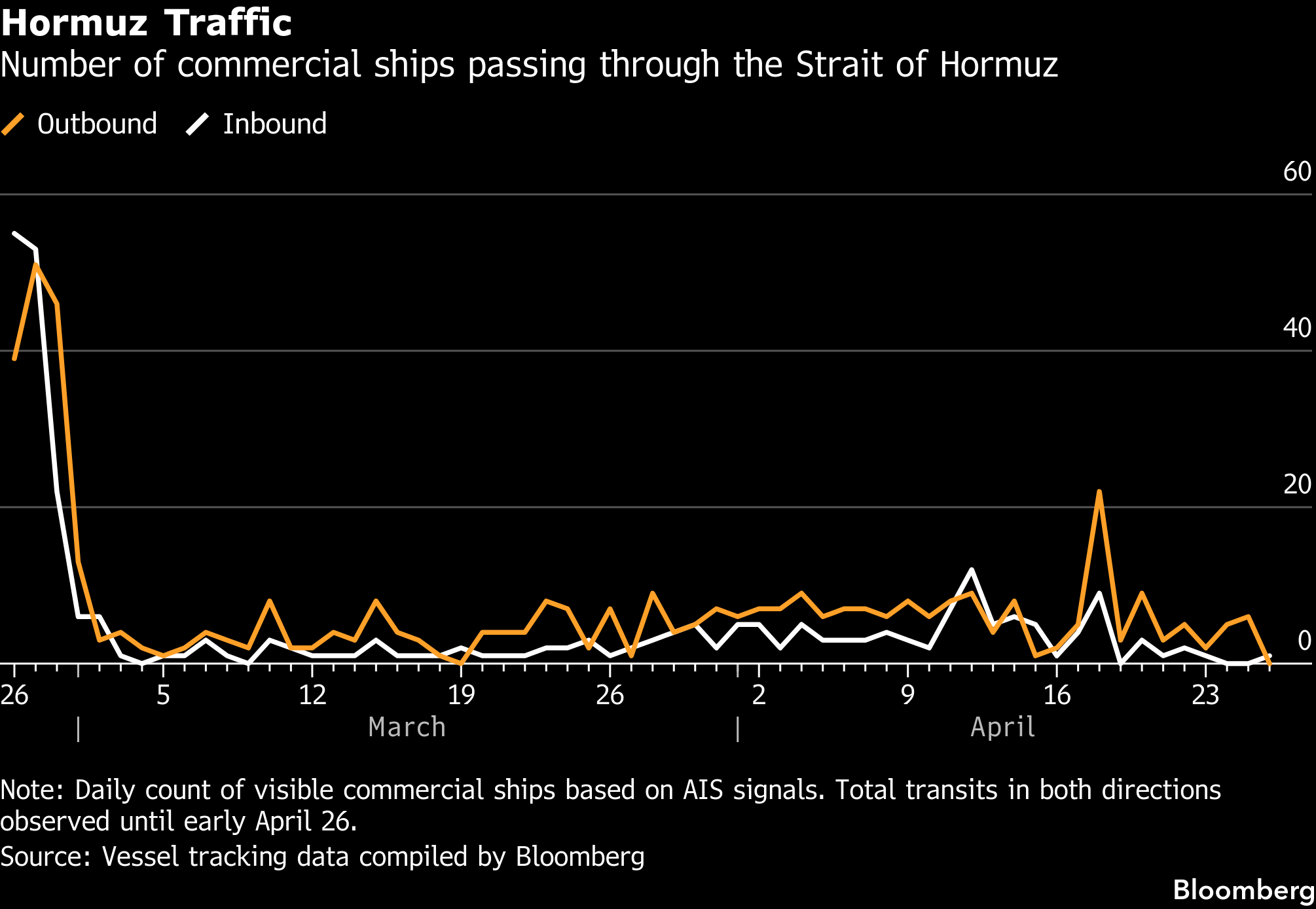
(Bloomberg) -- Traffic through the Strait of Hormuz has remained at a near-complete halt, with neither Iran nor the US showing any sign of easing their blockades of maritime traffic.
Peace talks between the two sides stalled again after US President Donald Trump canceled a planned trip by his top envoys to Islamabad in Pakistan, saying that Iran had “offered a lot, but not enough.” Iran’s President Masoud Pezeshkian said his nation won’t enter “imposed negotiations under threats or blockade,” adding that trust won’t be rebuilt “without ending hostile actions.”
As of Sunday morning, observable traffic leaving the Persian Gulf through Hormuz was down to a small coastal cargo ship, vessel-tracking data compiled by Bloomberg show. A small chemicals and oil-product tanker was the only one seen making its way in the opposite direction. The waterway has been largely empty since Iranian gunboats fired at ships and US military intercepted Tehran’s vessels in the past week.
Iran continues to fill supertankers with millions of barrels of crude, even as it remains unable to deliver them. A satellite image from Sunday morning covering Kharg Island and the surrounding waters shows two very large crude carriers moored at the terminal and at least 19 other ships anchored nearby.
The vessels seem to be congregating off Kharg — and another group accumulating near Chabahar close to the border with Pakistan — as the US Navy prevents Iran-linked ships from moving out of the Gulf of Oman. American forces intercepted the sanctioned M/V Sevan in the Arabian Sea on Saturday, the latest incident after other vessels were turned around last week while at least two others were boarded in Asia.
The US has dialed up the pressure by sanctioning Hengli Petrochemical (Dalian) Refinery Co., one of China’s largest private oil refiners, citing its purchases from Iran. The move reflects a broader push to isolate buyers of Iranian oil. China has been the top importer.
Ship Movements
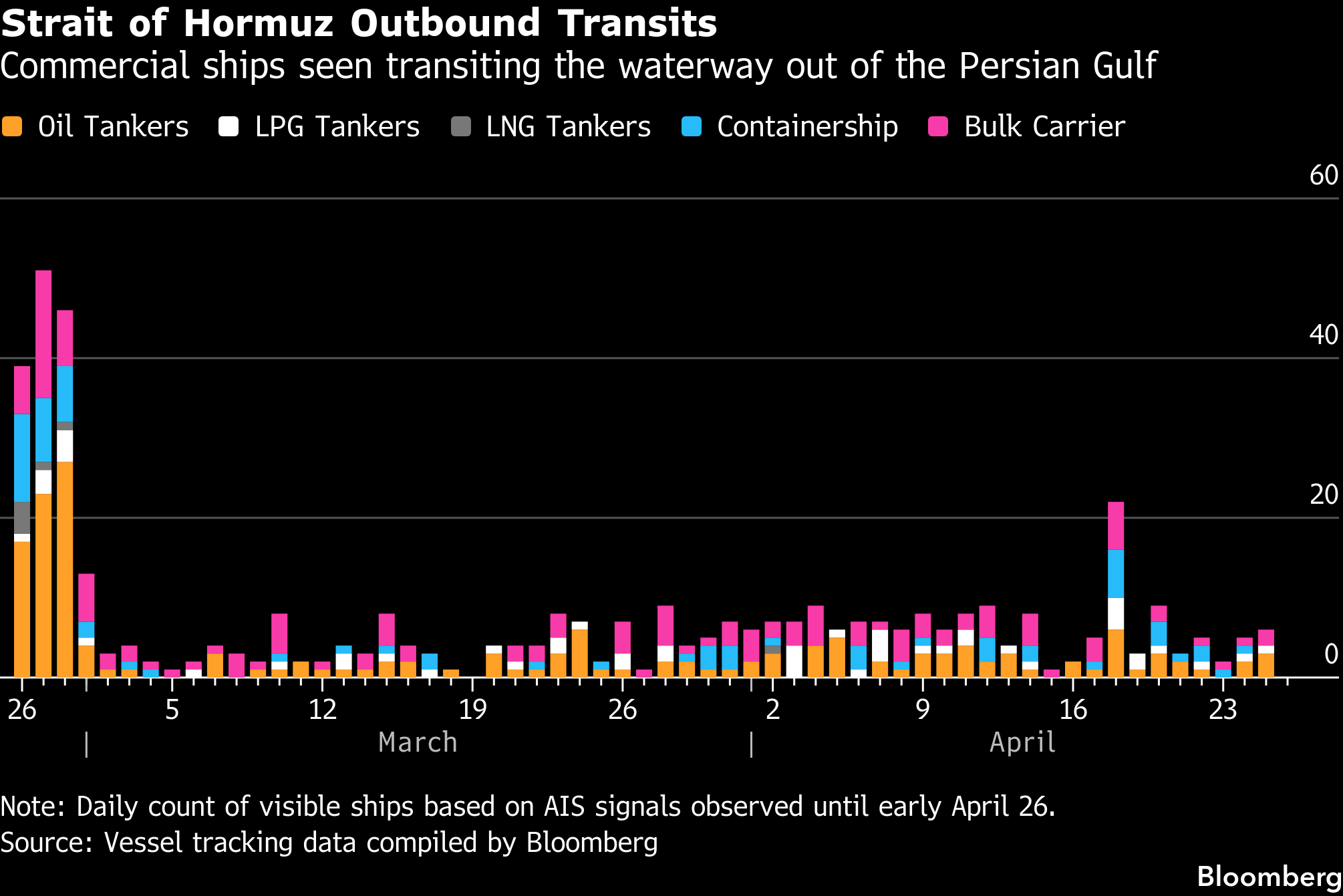
Ships observed leaving the Persian Gulf since Saturday morning were limited to three small oil tankers, a small LPG tanker, two bulk carriers and two small coastal cargo ships.
Two of the tankers, both of which crossed on Saturday, are sanctioned by the US and are now anchored off Oman near Shinas. The third, a small products carrier, left Dubai on Thursday and was last seen exiting the strait on Sunday morning. Its destination is unclear.
Tracking signals suggest the LPG tanker left Iraq’s Umm Qasr port in mid-April and that it, too, is now anchored off Oman. One of the bulk carriers followed a similar route.
The other bulker is hugging the Iranian coastline, heading east through the Gulf of Oman.
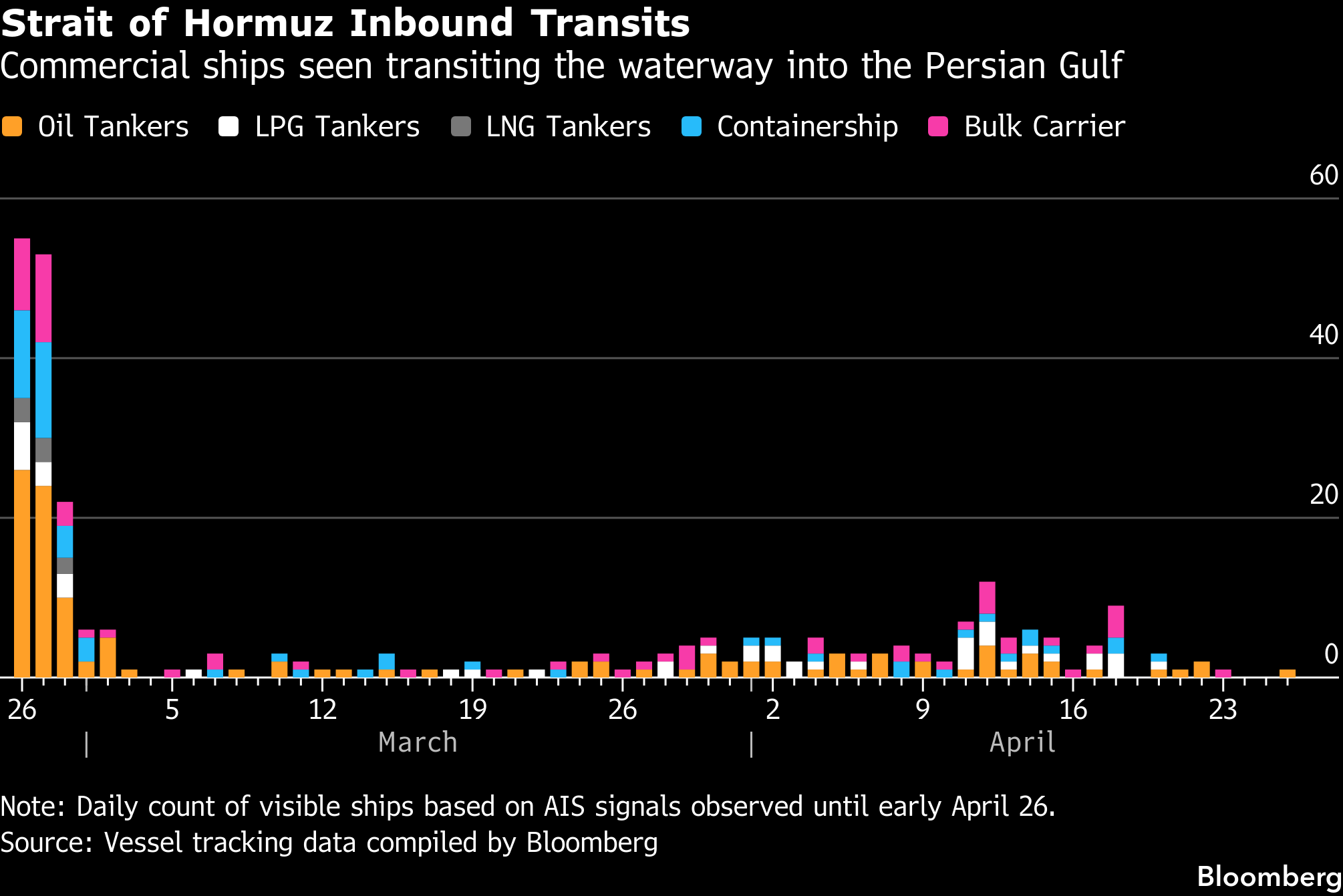
Observed inbound traffic since the start of Saturday has been limited to a single small chemical/oil products tanker and two tiny coastal cargo ships.
The tanker was heading past Iran’s Qeshm Island, signaling its destination as Hamriyah in the United Arab Emirates. One of the cargo ships has gone to Khasab at the tip of Oman’s Musandam Peninsula, while the other is heading along the Iranian coast.
Vessels transiting Hormuz with active Automatic Identification System signals during the past day were confined to a narrow northern lane near the Iranian islands of Larak and Qeshm, a route approved by Tehran.
The US blockade may encourage Iran-linked ships entering or leaving the Persian Gulf to switch off their tracking signals to avoid detection, making it harder to get an accurate picture of traffic through the waterway. This means transit figures may sometimes be revised higher when vessels reappear far away from the riskiest waters.
It was common, even before the US imposed its latest restrictions, for Iran-linked ships to stop sending signals as they headed into the Strait of Hormuz to exit the Persian Gulf. They generally didn’t enable them again until well into the Strait of Malacca in South East Asia, about 13 days sailing from Iran’s Kharg Island.
NOTES:
Because vessels can move without transmitting their location until they’re well away from Hormuz, automated positioning signals were compiled over a large area covering the Gulf of Oman, the Arabian Sea and the Red Sea to detect those that may have departed or entered the Persian Gulf.
When potential transits are identified, signal histories are examined to determine whether the movement appears genuine or is the result of spoofing — where electronic interference can falsify the apparent position of a ship.
Some transits may not have been detected if vessels’ transponders haven’t been switched back on. Iran-linked oil tankers often steam from the Persian Gulf without broadcasting signals until they reach the Strait of Malacca about 10 days after passing Fujairah in the UAE. Other ships may be adopting similar tactics and won’t show up on tracking screens for many days.
This tracker will be published during heightened tensions involving Iran, and aims to capture traffic for all classes of commercial shipping.
©2026 Bloomberg L.P.








