

Hormuz Shipping Traffic Grinds to a Halt as Tensions Deepen


(Bloomberg) -- Observed transits of commercial ships through the Strait of Hormuz have come to a halt following a brief surge on Saturday as tensions ratcheted higher after vessels came under gunfire in the waterway and Iran warned against crossings.
No crossings were seen on Sunday, according to tracking data compiled by Bloomberg as of early afternoon in London. At least 13 oil tankers turned back toward the Gulf on Saturday, abandoning attempts to leave that began after Iran’s Foreign Minister Abbas Araghchi announced a day earlier that the strait was open.
But Tehran again shut the waterway following a refusal by the US to lift its own naval blockade of Iran’s vessels. It followed a period of chaos when some ships tried to race out after Araghchi’s comments, only for many to U-turn. It’s keeping millions of barrels of oil and large quantities of liquefied natural gas locked within the Gulf, threatening to prolong an energy crunch that’s roiled the global economy.
The UK Maritime Trade Operations said Saturday a tanker was approached by IRGC gunboats off the coast of Oman before being fired at. A container ship was then hit by an unknown projectile in a separate incident while another commercial vessel reported a splash close to it, the UKMTO said later.
The incidents came soon after Iran said it would allow ships to pass through Hormuz for the duration of a ceasefire between Israel and Tehran’s Lebanon-based ally, Hezbollah. US President Donald Trump repeated that the strait was open, but said that a US Navy blockade of Tehran’s vessels would remain. Iran said that was unacceptable and Hormuz was once again closed.
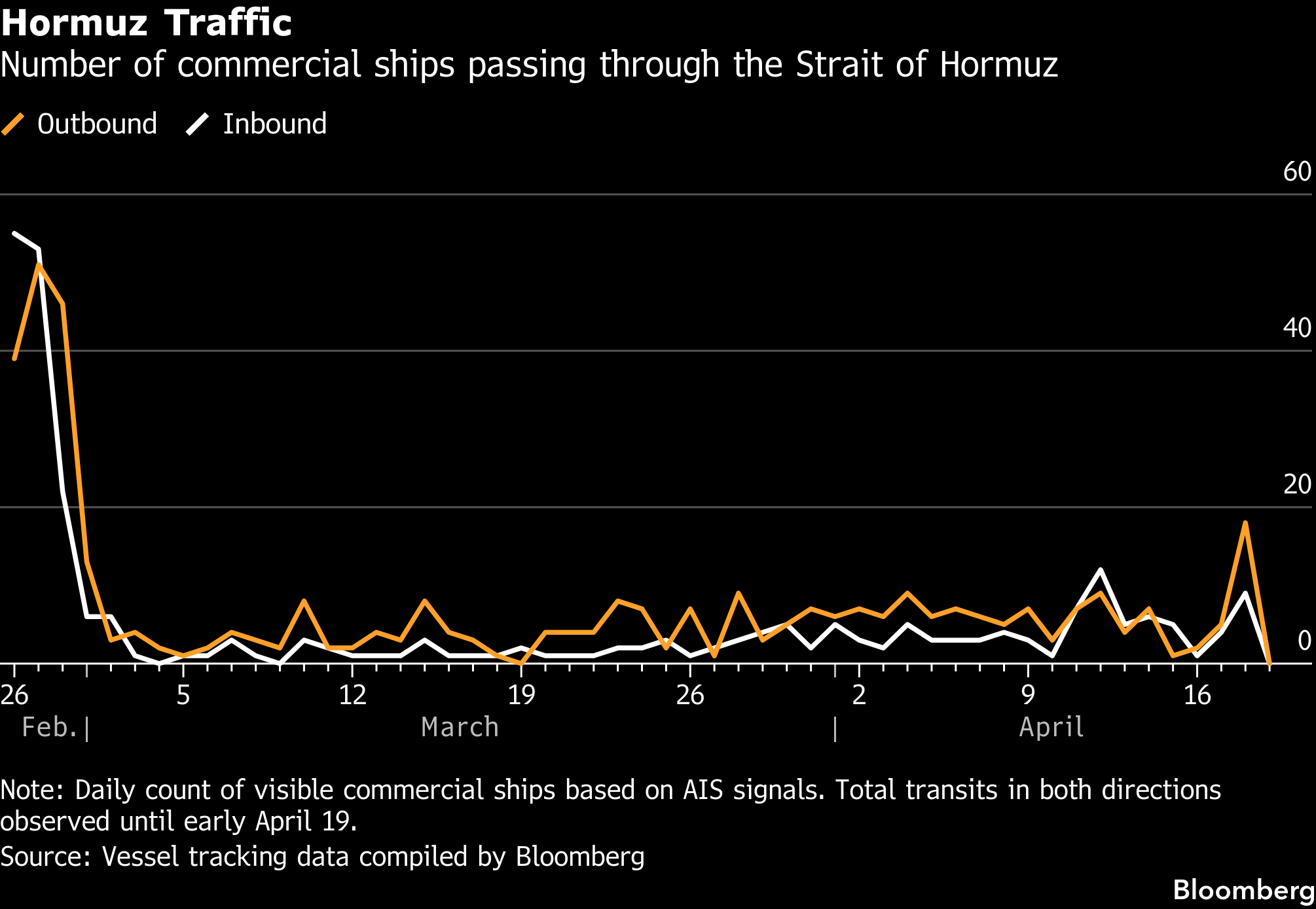
In the short period before Iran closed the Strait of Hormuz again, four tankers, including one hauling 2 million barrels of Saudi and Qatari crude, made it through early Saturday. A total of 18 commercial ships managed to complete outbound transits in the period. Ten ships made the inbound crossing, vessel-tracking data compiled by Bloomberg show.
Nearly half of the ships that did get out had links to Iran and eight of them are sanctioned by the US. None of those sanctioned vessels seem to have successfully broken the US blockade further out in the open sea in the Gulf of Oman. Three anchored off Khor Fakkan in the UAE and two made it as far as the Omani coast, although one then appeared to head back toward Hormuz 12 hours later.
Two more are heading east along the Iranian coast, but have yet to reach Chabahar, close to the border with Pakistan, where ships previously taking the same route have come to a halt. It did briefly look as though one ship, the LPG tanker Raine, would run the blockade, but it turned back toward Hormuz shortly after crossing a line from the Iran/Pakistan border to the easternmost point of Oman, suggesting.
Separately, four cruise ships made a dash to get out of the Gulf on Saturday, steaming at speed while hugging the Omani coastline and separated by just 45 minutes as they rounded the tip of the Musandam Peninsula. A fifth had made the outbound trip on Friday. All were reported to be empty and all are linked to European cruise operators. These ships are not included in the charts.
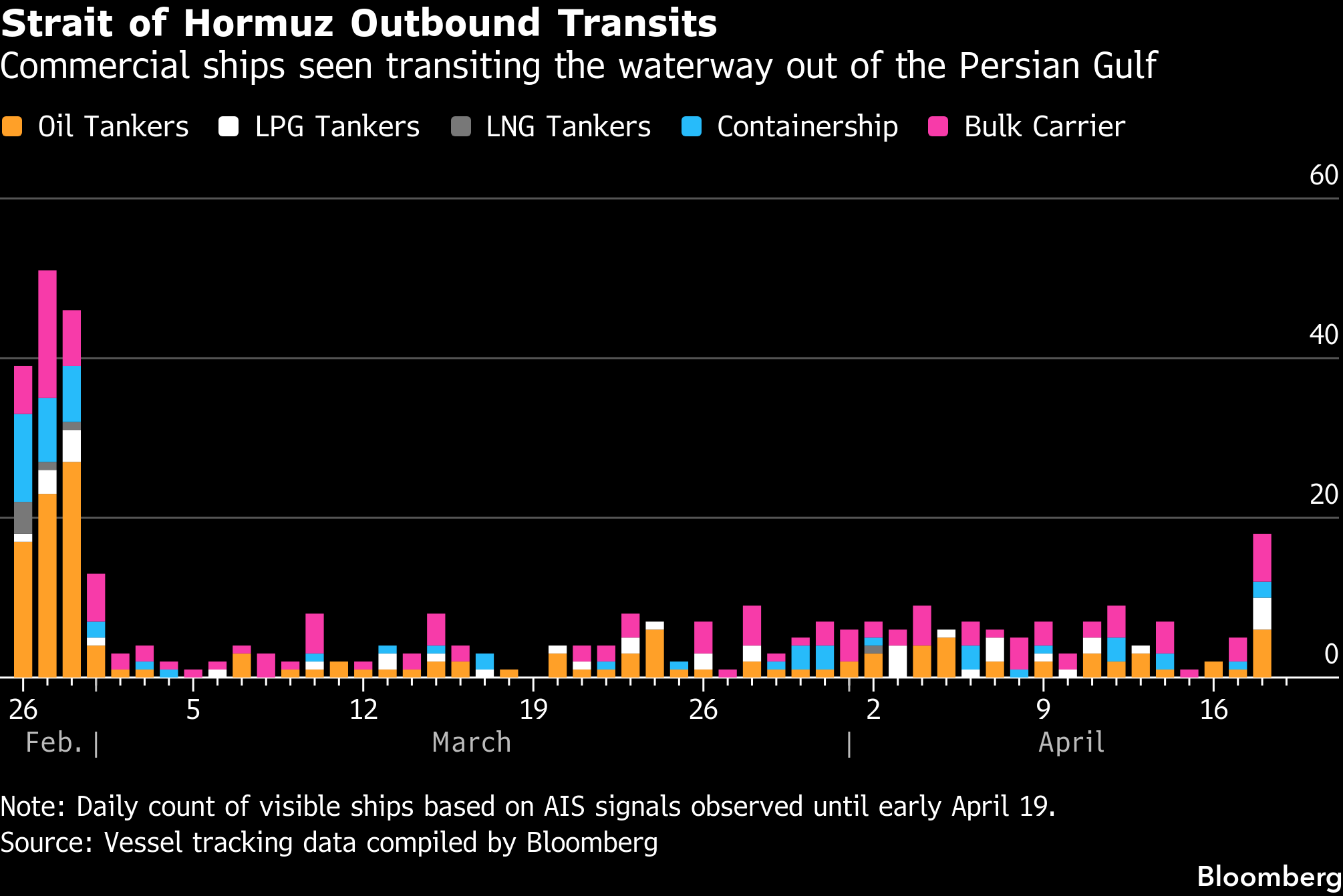
The blockades may encourage ships to switch off their tracking signals to avoid detection, making it harder to get an accurate picture of what’s going through. This means transit figures will sometimes be revised higher, when vessels pop up far way from the riskiest waters.
Inbound transits on Saturday included three LPG tankers ships, four bulk carriers and two container ships, both sanctioned by the US for their links to Iran.
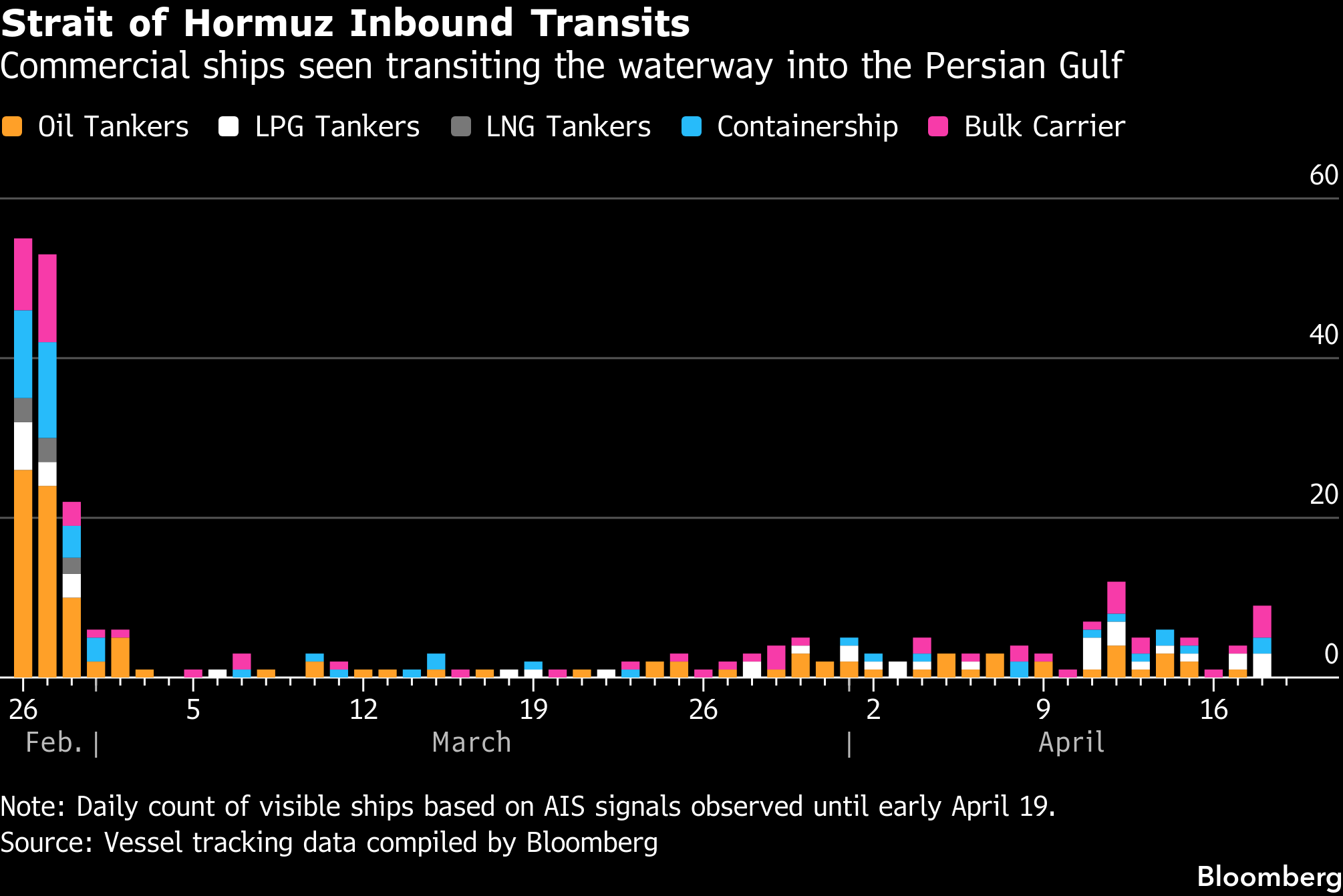
One cargo ship heading into the Gulf on Sunday morning has been halted off the Iranian port of Bandar Abbas at the apex of the strait, tracking data show.
NOTES:
Because vessels can move without transmitting their location until they’re well away from Hormuz, automated positioning signals were compiled over a large area covering the Gulf of Oman, the Arabian Sea and the Red Sea to detect those that may have departed or entered the Gulf.
When potential transits are identified, signal histories are examined to determine whether the movement appears genuine or is the result of spoofing — where electronic interference can falsify the apparent position of a ship.
Some transits may not have been detected if vessels’ transponders haven’t been switched back on. Iran-linked oil tankers often steam from the Persian Gulf without broadcasting signals until they reach the Strait of Malacca about 10 days after passing Fujairah in the UAE. Other ships may be adopting similar tactics and won’t show up on tracking screens for many days.
This tracker will be published during heightened tensions involving Iran, and aims to capture traffic for all classes of commercial shipping.
©2026 Bloomberg L.P.








