

Putin, Orban Discuss Fate of Russia’s Sanctioned Oil Refineries


(Bloomberg) -- President Vladimir Putin and Hungarian Prime Minister Viktor Orban met at the Kremlin on Friday to discuss the fate of sanctioned Russian refineries that have triggered concerns about fuel shortages across eastern Europe.
Hungary’s potential purchase of such Russian assets was a subject of the talks, Interfax reported, citing Deputy Prime Minister Alexander Novak, who added that discussions needed to be conducted out of the public eye.
“We have extensive cooperation in the energy sector, which is very good,” Putin said at the start of the meeting. “And there are issues and problems here that require our discussion.”
Orban’s unannounced visit to Moscow came a day after a meeting with Serbian President Aleksandar Vucic, where he said that Hungary would be “happy” to take a stake in Gazprom-owned NIS, the Balkan country’s sole refinery. Serbia is facing a fuel crisis after US sanctions imposed over the facility’s Russian ownership effectively shut down NIS. Hungary, by contrast, was awarded an exemption from US oil sanctions following Orban’s Nov. 7 meeting with US President Donald Trump.
Orban’s trip coincided with intensified efforts by Washington to secure a peace accord between Russia and Ukraine. The plan was initially centered on a 28-point plan proposed by the US but developed with Russian involvement. US presidential envoy Steve Witkoff is expected to visit Moscow next week.
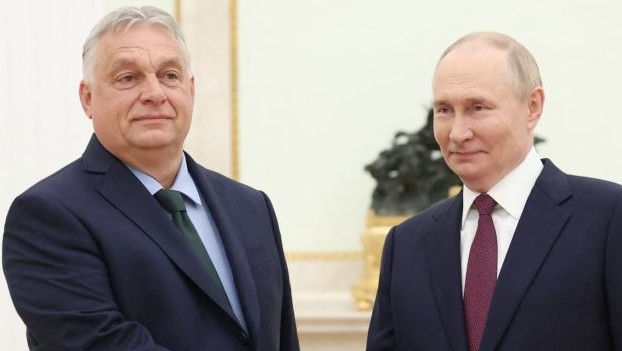
Orban has long tried to cast himself as a potential broker to end Russia’s war in Ukraine, which will reach the four-year mark in February, although his self-styled “peace missions” have upset European Union allies.
“He’s traveling without a European mandate, and without consulting us,” German Chancellor Friedrich Merz said Friday during a news conference. “But that’s nothing new.”
Trump in October announced a plan to meet Putin in Budapest in what would have been the pair’s second summit of the year, but the idea was dropped when the US leader concluded there was little chance of progress on ending the fighting at the time.
Orban again proposed Hungary as a potential site for peace negotiations during three and half hour of talks on Friday, Foreign Minister Peter Szijjarto said after the Kremlin meeting.
Szijjarto said Putin reaffirmed Russia’s commitment to continue supplying Hungary with natural gas and crude oil, and the sides agreed to continue the Russian-led expansion of Hungary’s sole nuclear power plant at Paks.
Orban, 62, who’s widely seen as the most Kremlin-friendly leader in the EU, is seeking to leverage his ties to Putin to potentially snap up sanctioned Russian energy assets in eastern Europe. They include Lukoil PJSC refineries in Bulgaria and Romania as well as the NIS facility.
Cabinet Minister Gergely Gulyas said on Thursday that the Hungarian energy company Mol Nyrt was holding talks with Serbia to help it dislodge Gazprom’s ownership and resume fuel flows.
“If the Orban-Putin talks produce any tangible outcome, it could be the Russian president’s approval for the Hungarian energy company MOL to acquire a majority stake in the Serbian energy company NIS,” Daniel Hegedus, a political scientist who’s director for central Europe at the German Marshall Fund in Berlin, said before the talks.
Orban also has close ties to Trump, an ideological ally, who granted Budapest an exemption from the US sanctions on Russian oil that are aimed at exerting pressure on Putin to end his full-scale invasion of Ukraine.
Others haven’t managed to extract such leniency. Bulgaria this month seized control of Lukoil’s local Neftohim refinery and its network of 220 gas stations to keep fuel flowing. Romania, which has a Lukoil-controlled refinery and a network of more than 300 Lukoil fuel stations, has drawn up legislation to allow it to do the same if deemed necessary.
Vucic has struggled to convince the US to grant a sanctions waiver as he attempts a foreign-policy balancing act between the West and Russia. He’s been hesitant to nationalize the NIS refinery out of concern about alienating Putin.
Companies from the United Arab Emirates are among those with which Russia is negotiating for Gazprom’s stake in NIS, Vucic said on Nov. 25. For the Lukoil stake in Bulgaria, a consortium of Azerbaijan’s state-owned SOCAR and Turkey’s private Cengiz Holding had been seen as the preferred buyer before US sanctions were imposed, though Mol also filed a bid.
©2025 Bloomberg L.P.