

Market outlook: energy security and the quest for new strategic energy corridors


Global energy systems remain heavily dependent on a small number of physical chokepoints, none more strategically consequential than the Strait of Hormuz. Roughly 20 million barrels per day (mbpd) of crude oil an d petroleum products transit the corridor, accounting for close to 20% of global oil consumption and approximately one quarter of global seaborne oil trade. Over 80% of these shipments are directed to Asian markets. The Strait is even more critical for global gas markets. Around 93% of Qatar and around 96% of the United Arab Emirates’ (UAE) LNG exports travel through the Strait.
Recent disruption scenarios have reinforced a structural reality: concentrating global energy flows through one maritime chokepoint creates systemic vulnerability for both producers and consumers. While Gulf producers will remain central to global energy supply for decades, reliance on this corridor exposes both exporters and importers to significant geopolitical and operational risk.
 Recent disruption scenarios have reinforced a structural reality: concentrating global energy flows through one maritime chokepoint creates systemic vulnerability for both producers and consumers.
As a result, energy strategy across the Gulf is shifting. The focus is moving beyond production capacity toward ensuring continuity of supply under disruption through route diversification, infrastructure redundancy, and the development of alternative export corridors. Recent investment decisions reflect this shift, including the UAE’s plans to expand export capacity via Fujairah, strengthening its ability to bypass the Strait.
This evolving approach signals a broader transition in how energy security is defined. Control over resources alone is no longer sufficient; resilience increasingly depends on the ability to sustain multiple, flexible routes to market. In a more fragmented and volatile geopolitical environment, the robustness of energy corridors is becoming as critical as the resources they carry.
The fiscal consequences of Hormuz disruption
Over 70 days of sustained escalation risk, disruption is already hitting global oil, gas, shipping and industrial markets. As the disruption continues, Brent crude is increasingly pushed into higher price bands, moving from a baseline of US$70–85 per barrel toward US$110–150 or higher depending on duration, spare capacity use, and coordinated strategic reserve releases.
The financial effects extend well beyond crude prices alone. Tanker insurance premiums in the Gulf have historically increased up to tenfold during periods of regional instability, while freight volatility, rerouting costs, and shipping delays have amplified uncertainty across global supply chains. Even partial rerouting around the Arabian Peninsula materially increases voyage time and operating costs for cargoes moving toward Europe and Asia.
LNG markets are highly exposed due to Qatar’s concentration of exports through the Strait. With Qatar accounting for roughly 20% of global LNG trade, the disruption has tightened spot markets and intensified competition for cargoes from the US, Australia, and Africa.
20 mbpd
Of crude oil and petroleum products transit the corridor
77 mtpa
The amount of crude oil Qatar exports
The inflationary impact is already global, with higher transportation costs, input prices, and energy bills feeding into manufacturing, chemicals, aviation, and food supply chains. In this context, the cost of concentrated infrastructure exposure arguably increasingly exceeds the cost of building redundancy.
Uneven exposure across Gulf producers
Not all Gulf and Middle East producers face the same degree of vulnerability. While several states have invested heavily in bypass infrastructure over the past two decades, others remain structurally dependent on uninterrupted transit through the Strait of Hormuz.
Kuwait, Bahrain, and Qatar remain among the most exposed. Kuwait exports roughly 1.2 mbpd of crude oil, while Qatar exports about 77 million tonnes per annum (mtpa) of LNG, along with condensates and petroleum products. Bahrain’s refining and export system is similarly reliant on Gulf shipping routes.
Unlike Saudi Arabia and the UAE, which have developed pipeline networks and export terminals that partially bypass the Strait, these states have limited redundancy, leaving them more exposed to geopolitical escalation, maritime incidents, or prolonged disruptions. This creates differentiated strategic incentives across the region: those with alternative corridors have greater flexibility during a crisis, while others face higher fiscal exposure and reduced export optionality.
Asia’s strategic exposure and the search for alternatives
The strategic implications of the Strait’s vulnerability are most acute in Asia, the primary destination for Gulf hydrocarbon exports. China, India, Japan, and South Korea together absorb the bulk of crude oil and LNG flows transiting the Strait, leaving Asian industrial economies disproportionately exposed to disruption.
China imports approximately 11–12 mbpd of crude oil, with over 50% originating in the Middle East. India imports around 5 mbpd, of which over 60% comes from Gulf suppliers. Japan and South Korea are even more concentrated, with Gulf producers supplying around 90% and 70% of crude imports, respectively.
While global markets can eventually rebalance through rerouted flows and higher prices, Asia remains structurally dependent on uninterrupted Gulf-to-Asia maritime transit for refining, power generation, and industrial stability.
This exposure is shaping long-term infrastructure and investment strategies across Eurasia. China’s Belt and Road Initiative, with almost US$1.4 trillion in infrastructure commitments, alongside the US$62 billion China–Pakistan Economic Corridor (CPEC), reflects efforts to diversify logistics networks away from concentrated maritime routes.
Expanding existing bypass infrastructure as strategic insurance
The UAE has already demonstrated the value of route diversification through the Abu Dhabi Crude Oil Pipeline (ADCOP), a 360km link from Habshan to Fujairah on the Gulf of Oman that entirely bypasses the Strait of Hormuz. With a nameplate capacity of around 1.5 mbpd, reportedly pushed closer to 1.8 mbpd during periods of heightened regional risk, it provides critical export continuity during maritime instability. On 15 May, the UAE announced it would accelerate construction of a new oil pipeline that will double its export capacity through Fujairah by 2027, vastly expanding its ability to bypass the Strait of Hormuz.
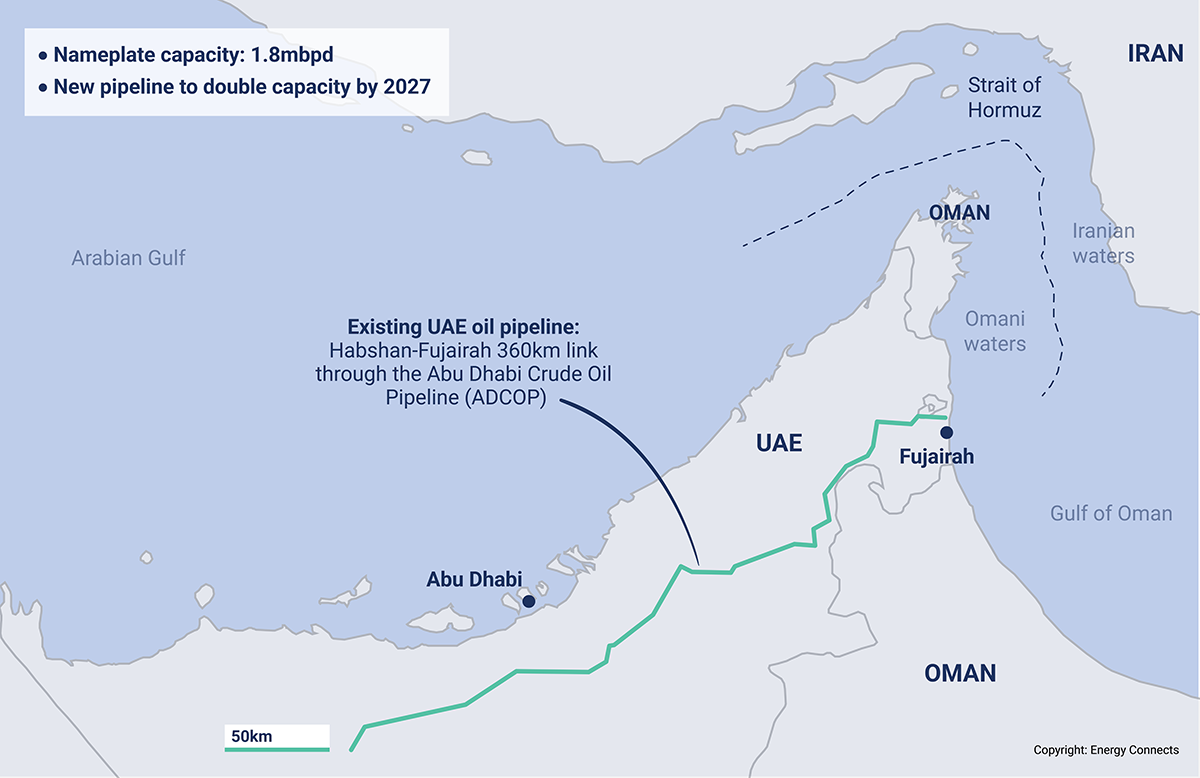
For ADNOC, the pipeline marks a major milestone in the company’s long-term infrastructure expansion plans. By creating a direct export route to Fujairah, ADNOC has significantly reduced reliance on maritime transit through the strait. Fujairah has evolved into a major energy storage and export hub, handling about 1 mbpd of Murban crude exports in 2024 while also serving as a key bunkering and logistics centre connected to global shipping routes outside the Gulf chokepoint system.
Saudi Arabia has pursued a similar strategy through its East-West Petroline, connecting the Eastern Province to Yanbu on the Red Sea. It possesses an estimated capacity of 5–7 mbpd and enables large-scale export without reliance on Gulf maritime transit.
These projects reflect a broader shift in Gulf energy planning. Infrastructure redundancy is no longer viewed as an efficiency consideration but geopolitical insurance to secure export continuity under stress.
From isolated bypasses to integrated continental corridors
The next phase of resilience extends beyond standalone pipelines, with a growing focus on integrated continental networks combining pipeline, rail, and port to move hydrocarbons and strategic commodities more flexibly.
A key case is Iraq’s export connectivity from Basra to Türkiye via the Iraq–Türkiye Pipeline (ITP) at Ceyhan. Despite repeated outages and political disputes, its nominal capacity of around 1.6–1.7 mbpd makes it Iraq’s main overland route to Mediterranean markets. While southern Basra terminals still handle most exports, northern flows via Ceyhan remain the only large-scale overland outlet toward Europe.
11-12 mbpd
China’s crude imports, with over half from the Middle East
US$2t+
Annual energy cost shift potential under major price disruption
Dormant infrastructure is also being reassessed. The Iraqi Pipeline through Saudi Arabia (IPSA), once designed to transport crude westward, had a capacity of roughly 1.65 mbpd before being shut in the early 1990s. Trans-Arabian Pipeline (Tapline), linking Saudi Arabia’s Eastern Province to the Lebanese port of Sidon, peaked at around 0.5 mbpd before closing in the 1980s.
Even Syria, despite political fragmentation, sanctions, and infrastructure damage, retains geographic relevance as a theoretical corridor, such as the Kirkuk-Baniyas oil pipeline between Iraq and the Mediterranean. While revival remains unlikely in the near term, it continues to feature in long-term discussions on energy security, redundancy, and alternative routes beyond chokepoint-dependent maritime routes.
Rail and multimodal logistics as resilience infrastructure
Energy corridor resilience is increasingly extending beyond pipelines alone, with rail emerging as a complementary mechanism for trade continuity, industrial integration and logistical flexibility across the Gulf and wider Middle East.
Projects such as the UAE–Jordan rail initiative reflect a broader movement toward multimodal corridors linking Gulf producers with Levantine and Southern European markets. While rail cannot replace pipeline-scale hydrocarbons, it strengthens resilience by diversifying inland logistics and improving inland-to-port connectivity for bulk commodities. The corridor is expected to handle around 16 mtpa of freight, primarily supporting Jordan’s phosphate and potash exports via Aqaba, while potentially linking to wider Gulf–Levant–Mediterranean networks over time.
US$5-20bn
The typical capital expenditure required by large-scale cross-border pipeline systems
More broadly, GCC rail integration plans envision around 2,100 km of regional rail connectivity across Saudi Arabia, the UAE, Oman, Kuwait, Bahrain, and Qatar, with investment costs exceeding US$15 billion across multiple national segments.
The strategic objective is increasingly the development of overlapping transport systems — pipelines, rail, ports, storage hubs, and industrial corridors — to reduce exposure to disruption on any single route.
The economics of resilience
Large-scale cross-border pipeline systems typically require capital expenditure of US$5-20 billion, depending on terrain, route complexity, export capacity and security conditions. For comparison, the East African Crude Oil Pipeline (EACOP) is estimated at over US$5 billion, while major transcontinental gas projects such as the Trans Anatolian Natural Gas Pipeline Project cost between US$8-12 billion and the major Power of Siberia (part 1) project costs around US$55 billion.
Under stable market conditions, many redundancy projects have struggled to justify upfront costs given the efficiency and low operating expense of Gulf maritime transport. However, repeated disruption and sustained geopolitical fragmentation are already changing the economics. Under stress scenarios, higher oil prices, rerouting costs, insurance premiums, shipping delays, and broader supply-chain disruptions significantly increase the value of physical redundancy.
A price rise from US$75-130 per barrel across roughly 103 mbpd of global demand implies more than USD$2 trillion in annual energy cost shifts, while also significantly boosting revenues for exporting states. This increases the fiscal space available for Gulf producers to fund redundancy infrastructure, even if investment decisions remain driven primarily by long-term strategic and geopolitical factors.
The emerging blueprint for energy security
The central lesson of Strait of Hormuz’s closure is not just the resilience of Gulf energy supplies and the planning that went into creating alternative bypasses and corridors, but also the need for strategic expansion of supply routes. Global energy trade is shifting from single mega-routes towards layered, overlapping corridors designed to preserve continuity under disruption, with the Gulf states at the heart of it. Pipelines, rail, ports, storage hubs, and multimodal networks are increasingly treated as a single resilience system rather than standalone assets.
Energy security is therefore moving beyond reserves and production volumes toward a wider concept of corridor survivability and logistical flexibility. In an era of geopolitical fragmentation and recurring instability, energy power lies not only in underground resources, but in the ability to sustain multiple routes to market simultaneously.
- This Market Outlook report was produced as a part of ADIPEC’s Energy & Geopolitics series. For more information and coverage, visit: https://www.adipec.com/press-media/insights/








