

European Gas Slips on Report Iran Is Ready to Discuss Ending War

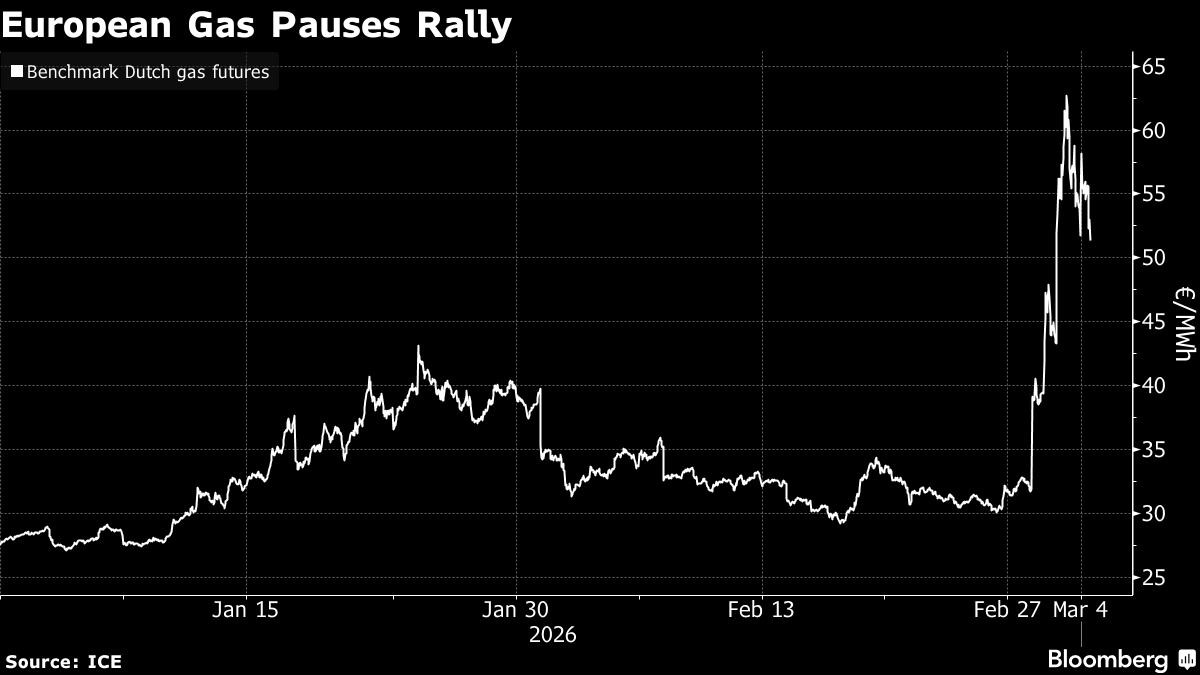
(Bloomberg) -- European natural gas halted its biggest rally in four years after a report that Iran is ready to discuss ending the conflict that has rattled energy markets.
Benchmark futures slipped as much as 9.5%, reversing an earlier gain. The New York Times reported that Iran operatives made an offer to discuss terms of ending the war, though US officials are skeptical — at least in the short term — that either side is ready for an offramp.
“The report suggests Iranian openness to talk,” said Rabobank energy strategist Florence Schmit. “But an actual decline of prices back to pre-March levels hinges on a cessation of attacks.”
So far, fears of deep disruption to global oil and gas supply are growing as fresh attacks flare in the Middle East, with gas gaining 70% in the previous two session. Major energy infrastructure is caught in the cross-hairs of the conflict, and the situation risks the most serious shock since Russia’s invasion of Ukraine in 2022 upended global energy trade.
The world’s largest liquefied natural gas plant in Qatar remains halted, and uncertainty over its restart is fueling worries over a supply crunch. The Straight of Hormuz — a key waterway for oil and LNG — remains largely closed, although President Donald Trump said on Tuesday that the US will insure vessels crossing the narrow waterway and escort them “if necessary.”
Read Also: Trump’s Hormuz Assurances Are Only a Partial Fix, Shippers Say
While Asian countries buy most of the LNG shipped from the Middle East, any prolonged disruption would increase competition for alternative supplies — keeping prices elevated worldwide, including in Europe.
The crisis hasn’t yet materialized in Europe’s physical supply as it takes around a month for Qatari cargoes to reach the continent, and vessels scheduled for March have already sailed. But the region is particularly vulnerable this summer, as it needs to buy large volumes of LNG to replenish depleted gas reserves.
Traders are also watching for potential tanker diversions from Europe to Asian countries or Egypt, which lost its pipeline supplies from Israel.
“With European storage already depleted and Asian spreads widening, there is limited buffer, and no clear ceasefire timeline to anchor expectations,” said Pallav Kant, a quantitative analyst at Energy Aspects.
The conflict erupted days after many investors had turned more bearish, leaving the market poised for a rally. As a result, implied volatility, a measure of how expensive the derivative contracts are, jumped to multiyear highs since the start of the week.
Trading volumes in the region’s key gas exchange jumped to fresh records earlier this week, while aggregate open interest in benchmark contracts slipped as many market players were forced to close positions after the rally.
“We’re seeing widespread position reduction and a rush to hedging — classic risk-off behavior in uncertain times,” said Marco Saalfrank, head of continental Europe merchant trading at Swiss-based Axpo Holding AG.
Dutch front-month futures, Europe’s gas benchmark, traded lower at € a megawatt-hour by 11:44 a.m. in Amsterdam. The contracts reversed earlier gains of as much as 13%.
©2026 Bloomberg L.P.