

China Sets Cautious Climate Target as Carbon Deadline Looms

(Bloomberg) -- China, the world’s top polluter, set a cautious new climate target for the rest of the decade, frustrating hopes for tighter policy that would accelerate the nation’s work to curb emissions.
A new goal pledges to cut carbon emissions per unit of gross domestic product by 17% by 2030, and compares to a previous objective to deliver an 18% reduction in the five years through 2025 — which annual reports said was narrowly missed.
“We will actively yet prudently work toward peaking carbon emissions and achieving carbon neutrality,” Premier Li Qiang said Thursday at the National People’s Congress, the once-a-year gathering of policymakers in Beijing.
President Xi Jinping’s target to hit a peak before 2030 will be “accomplished as planned,” and a system of controlling the total amount of carbon emissions — in addition to intensity targets — will also be implemented, the work report said.
New climate targets were set out alongside a raft of policies aimed at sustaining economic expansion at 4.5% to 5%, encouraging consumers to spend more, and advancing the country’s capabilities in cutting-edge technology — goals that the country’s leaders see as compatible with an acceleration of the green transition.
China has also demonstrated its “commitment as a responsible major country,” in setting out climate objectives through 2035 in a report lodged with the United Nations last year, the work report said. Critics have argued that strategy, which pledged a 7% to 10% cut in total greenhouse emissions, is too easily achievable.
Action over the next five years will be crucial in determining whether China meets Xi’s emissions deadline and gets on track to hit net zero by 2060. How quickly and aggressively the country can begin to reduce its outsized climate footprint is critical to the world’s prospects of limiting the impacts of global warming.
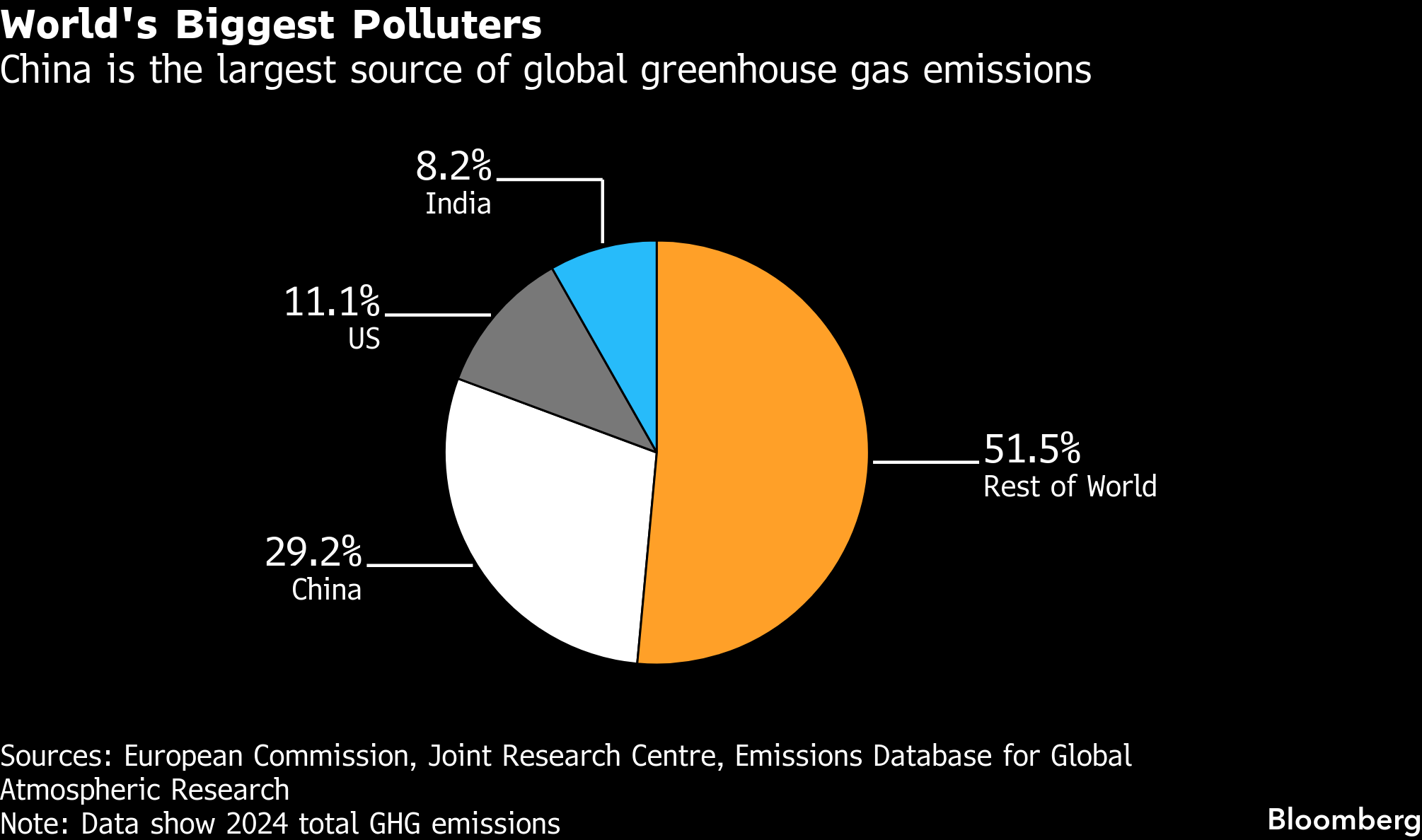
China accounted for about 29% of greenhouse gas pollution in 2024, compared to the 11% contributed by the US — the second-ranked nation. Since then, the US has revoked climate policies under President Donald Trump and saw emissions edge up last year, according to an analysis by Rhodium Group.
Reports issued by China’s ministries made commitments across a range of areas, pledging to offer further support for electric vehicles and green manufacturing, to continue the issuance of sovereign green bonds, and to increase penalties for transgressions of environmental laws.
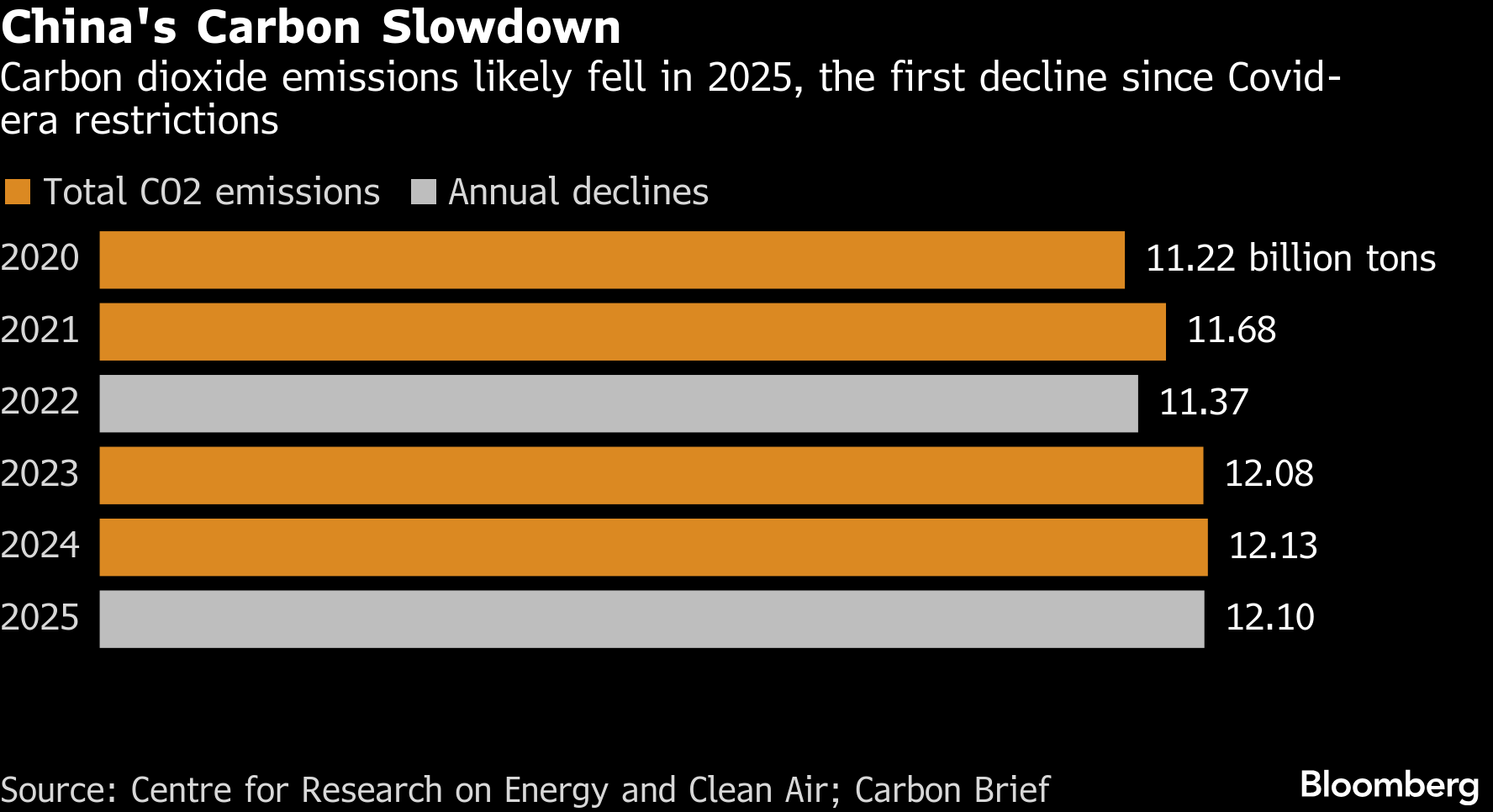
There have been recent signs of progress in China. Carbon emissions likely fell 0.3% in 2025, a first decline since Covid-era curbs, the Centre for Research on Energy and Clean Air, or CREA, said last month. World-leading adoption of renewable energy means China is now meeting growing electricity consumption without the need to burn more coal at power plants, while the dramatic rise of EVs has eroded demand for transport fuels.
Even so, China’s emissions trajectory over the coming years remains in question, as the country continues to break ground on new coal-fired power stations and carbon-intensive chemical plants.
The new carbon emissions intensity target — which includes a goal for a 3.8% reduction this year — may be calculated using a different methodology than in the past. On Saturday, China’s National Bureau of Statistics said it included emissions both from the energy sector and industrial processes in its methodology, whereas in previous years it didn’t specify emissions sources. Explicitly including industrial pollution will allow China to book reductions from the huge drop in cement production due to the property crisis.
Using the previous methodology, the CREA last month calculated that China had reduced its emissions intensity by about 12% from 2021 to 2025. The government’s reports Thursday said China had achieved a 17.7% cut.
That difference is significant to define the scale of China’s challenge to meet a commitment under the Paris Agreement to reduce emissions intensity 65% by 2030 from 2005 levels. Under the previous methodology, CREA had estimated China would need to achieve a 23% drop over the next five years, whereas the government insisted its new strategy would enable it to hit the Paris goal.
(Updates with additional details on emissions calculations in final two paragraphs.)
©2026 Bloomberg L.P.








