

Data Centers to Fuel Sharp Rise in Australia Power Demand


(Bloomberg) -- Power demand from data centers is poised to surge over the next quarter-century, adding to an almost doubling of electricity consumption across Australia’s main grid by 2050, according to the network operator’s latest road map.
Data centers will account for almost 10% of the National Electricity Market’s underlying demand by 2050 — four times their current share, the Australian Energy Market Operator said in its biennial Integrated System Plan. The report confirmed that the lowest-cost pathway is a system built around renewable energy, connected through transmission and distribution networks and firmed with storage and natural gas.
“Our plan is to deliver more cheaper, cleaner energy, using our sovereign sun and wind energy to shield our grid from global volatility,” said Minister for Climate Change and Energy, Chris Bowen.
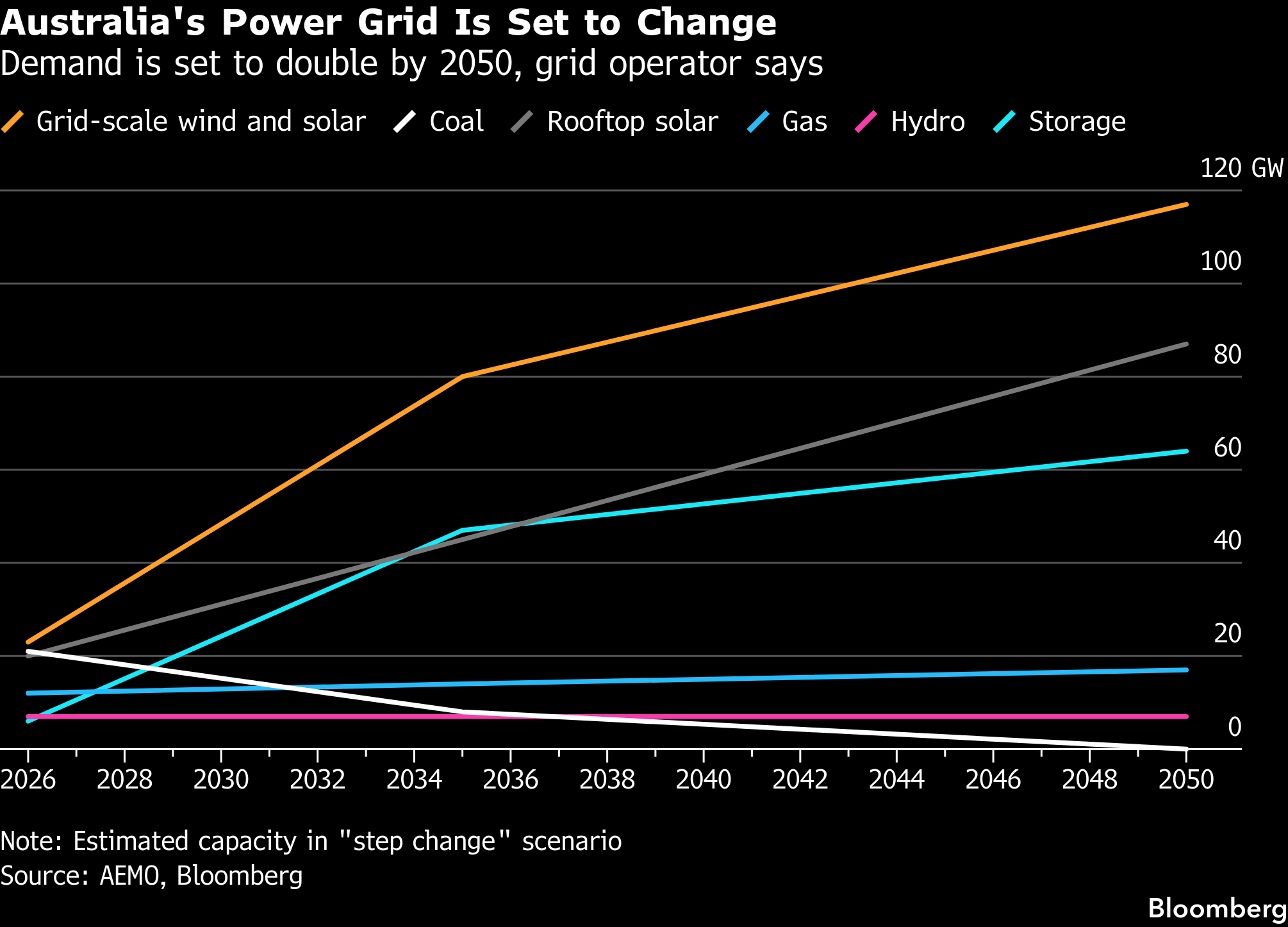
Australia’s slowing economy has been propped up by a massive surge in investment into data centers. That comes as the nation’s world-beating uptake of solar and rapidly aging coal generation helped to cause increased volatility and made the country a test case for the global energy transition.
Households are set to continue to contribute to the massive shift in generation through further uptake of solar panels and batteries. That will see their grid-supplied energy needs fall 44% to 20 terawatt-hours by 2025, despite increased uptake of electrical vehicles and appliances, according to the report.
“Households are already part of the solution,” said Jackie Trad, chief executive officer of the Clean Energy Council. “Rooftop solar is set to quadruple by 2050 and home batteries are taking off,”
More than a third of suitable dwellings in the National Electricity Market — which supplies about 85% of the nation’s population — have rooftop solar, which is set to rise to 56% by 2050. Meanwhile, small-scale battery capacity is set to jump to 35 gigawatts by 2050, from 5 gigawatts in April.
©2026 Bloomberg L.P.








