

America’s Biggest Wind Farm Arrives Just as Industry Heads for Declines


(Bloomberg) The largest wind farm in US history started operating this month, a massive complex of spinning turbines in New Mexico that will power more than a million homes in the Southwest.
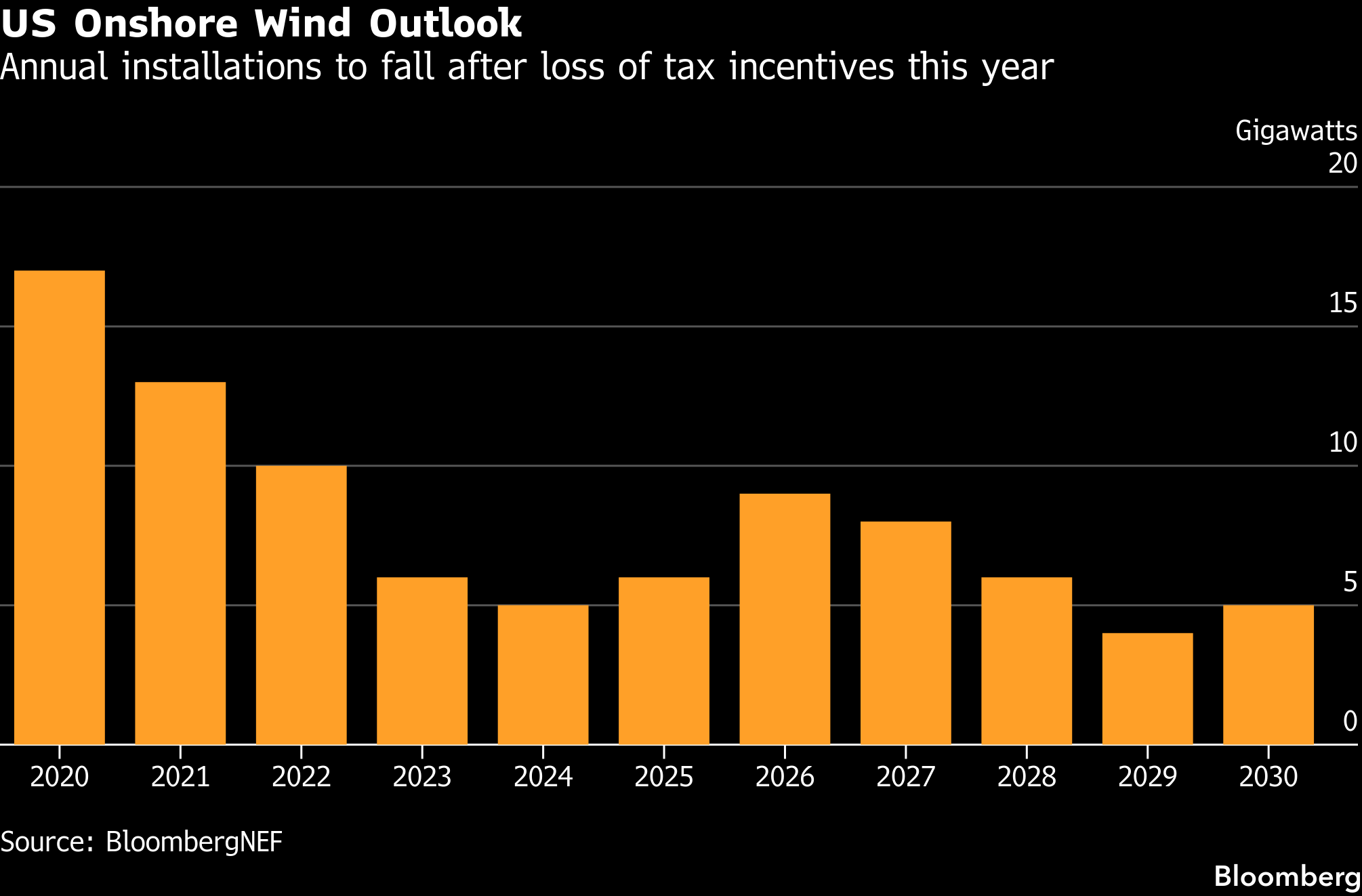
SunZia, as it’s called, will be the country’s last landmark wind project for some time. After this year, annual onshore wind power additions are forecast to decline until 2030, according to BloombergNEF.The biggest reason is President Donald Trump’s assault on renewable energy, and wind in particular. He has vowed to block new wind development in his second term. But Trump isn’t the only culprit: inflation, supply challenges and local opposition have complicated development since the Biden administration. The wind industry also has to contend with the end of lucrative tax credits this year, tariffs and long waits to connect to power grids.
“The development pipeline faces a lot of uncertainties,” said Diego Espinosa, a wind analyst for research firm Wood Mackenzie.
The wind sector is also losing out to other renewable energy sources. Even in the Trump era, solar easily provides the most new annual capacity, while batteries are also besting wind capacity additions each year. Solar generation is cheaper and faster to install, a critical factor in an era of surging demand from power-hungry data centers.
“Solar costs have continued to come down more than previously expected, and wind costs have been rising the past couple of years,” said Harrison Sholler, an analyst for BloombergNEF.
Developers of wind have fewer places where it makes economic sense to install their sky-high turbines compared with solar. And large swaths of those locations have already been built out — such as in the Texas panhandle — further limiting opportunities, Sholler said.
The wind industry has known that solar enjoys some inherent advantages, but it didn’t expect the breadth of Trump’s anti-wind campaign. The industry prospered during Trump’s first term despite him hating turbines long before entering politics.
In Trump’s second term, his administration has taken a series of actions to stop wind development. On his first day in office, Trump issued an executive order calling for a moratorium on approvals of wind projects on federal lands and waters, a decree that was ruled illegal in December by a federal judge in Boston. The administration also issued stop-work orders for five offshore wind farms, which were lifted after developers challenged the decrees in federal courts. Several clean energy groups accuse the Pentagon of halting security reviews of proposed turbines, which are needed to complete projects. The groups sued earlier this month to lift the alleged suspension, which they say is impacting more than 100 projects worth nearly $50 billion in investments. The US Defense Department didn’t respond to a request for comment on the lawsuit and allegations that the agency is blocking approvals.
David Carroll, chief executive officer of renewable developer Engie North America, said the inability to get permitting approvals has placed the wind industry in a precarious position.
“You’ve got capital investments that are just frozen,” said Carroll, who is also chair of the trade group American Clean Power Association. “You have boards of companies questioning whether they should continue to develop wind here in the US.”
Engie is still going to try to complete the more than a dozen wind projects that have been stalled by the permitting freeze, Carroll said.
“But we are not placing a lot of investment in the development of new wind at this moment, because the risk profile is too great,” he said.
©2026 Bloomberg L.P.