

Massive Storm Will Test Power Grids Across US This Weekend

(Bloomberg) -- Snow and dangerously bitter cold are expanding across the US Great Plains as the country’s largest winter storm prompts cascading travel chaos and threatens widespread power outages.
The storm is expected to span almost 1,500 miles (2,400 kilometers), bringing heavy snow, crippling ice and subzero wind chills to some of the nation’s biggest cities. Economic activity may grind to a halt along the storm corridor, and a dearth of road-clearing equipment and road salt in some places will complicate efforts to reopen highways.
Natural gas prices surged on concern iced-over equipment will choke supplies. Airlines canceled more than 6,200 flights and Amtrak pulled dozens of trips from its schedule. New York’s Metropolitan Transportation Authority urged customers to avoid unnecessary travel Sunday and Monday, warning of disruptions to subways, bus lines and commuter rail services.
“We are fixing to be attacked by a severe Arctic blast,” Houston Mayor John Whitmire said during a media briefing Friday. “There is going to be a severe storm like few Houston residents have ever experienced.”
Whitmire, a Democrat who leads the fourth-most populous US city, urged residents to go to libraries and other designated warming shelters. No one will be asked about their immigration status, he added.
In Chicago, schools were closed Friday as the third-largest US district braced for wind chills of -30F (-34), while ski resorts in Michigan took the unusual step of shutting slopes because of the extreme cold.
A US Senate vote has been postponed until late Tuesday because of the storm, Majority Leader John Thune’s office announced. Federal offices in the Washington DC area will be closed on Monday.
Former Federal Emergency Management Agency chief Deanne Criswell said during a Bloomberg Television interview that close to 200 million people are in the path of the weather system, which she described as “gigantic.”
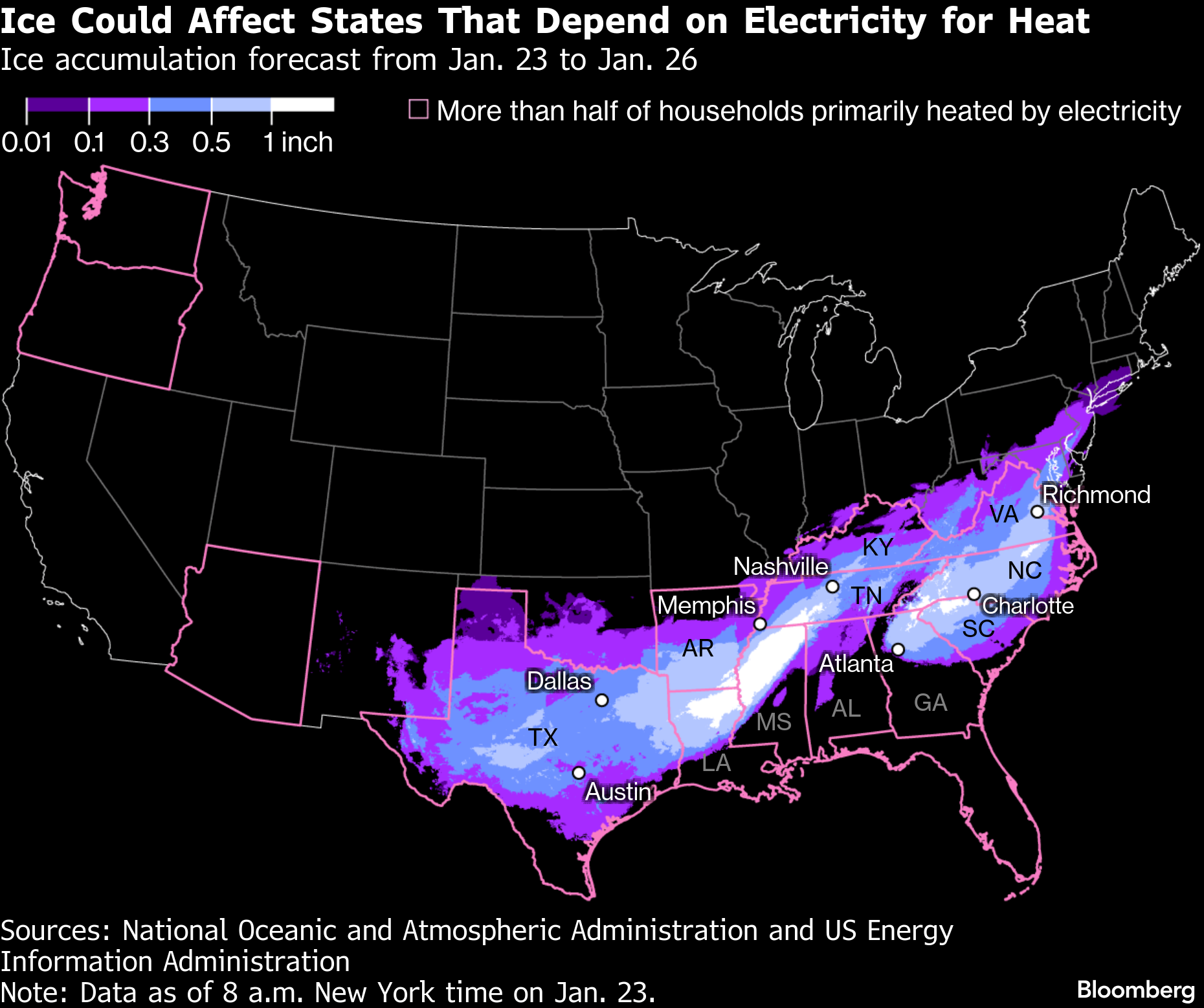
A wide swath of the South from Louisiana and Arkansas to the Appalachian Mountains is facing “catastrophic impacts” from freezing rain and ice, the US Weather Prediction Center warned.
Through Monday evening, Nashville and Charlotte could see roughly a half-inch (1.3 centimeters) of freezing rain. That’s enough to snap tree branches and power lines, potentially triggering widespread power outages. Parts of Mississippi will be lashed with more than an inch of ice.
The punch of polar air sent power prices soaring. Prices for electricity and natural gas — the No. 1 power-plant fuel, as well being widely used for home heating — jumped ahead of the storm and remain elevated.
State and local officials warned residents to prepare for power outages, frozen pipes and impassable roads. Snow and sleet are expected to cover major cities along a thousand-mile stretch from Oklahoma to New York. Boston may get walloped with more than 20 inches.
The snowfall is likely be one of the most expansive in the US since the 1993 “superstorm,” said Rob Carolan, chief executive officer of Hometown Forecast Services.
“I have a feeling we’re going to see problems with travel into early next week,” Carolan said. “It’s going to take a while for airlines to get aircraft back into airports so they can operate.”
Heavy snow will likely fall across the New York metro area beginning early Sunday, with more than a foot possible in some places before the storm subsides late Monday.
New York Governor Kathy Hochul said in an X post that she was activating the National Guard, with service members ready to respond in the lower Hudson Valley and New York City.
Winter storms are a primary peril in the insurance industry, similar to hurricanes. Most of the damage associated with such storms stems from prolonged freezing temperatures, according to reinsurance firm Swiss Re.
Based on the company’s data, the financial toll has been rising in recent years: Average annual insured losses from winter weather have more than tripled to $7 billion since 2021 compared with the preceding decade.
But experts say indirect losses caused by power outages — including food spoilage and missed work — can drive damages higher.
Within the storm’s footprint, “a typical weekday costs about $24 billion for every day of disruption,” said disaster modeler Chuck Watson of Enki Research, adding that economic activity tends to be somewhat lower on weekends.
The exact scope of financial losses from the impending storm will depend on how long it takes to restore power and clear roads, Watson said.
In Texas, Governor Greg Abbott issued disaster declarations for most counties in the state, which faces its biggest test since the deadly winter storm and widespread blackouts that followed almost five years ago.
Power supplies may also be affected because of minimal winds from Saturday through Monday afternoon, reducing wind-farm output, according Sean Kelly, CEO of Amperon, a Houston-based forecaster of power demand and renewable generation.
The biggest challenge for Texas may come Monday morning, when the power supply-demand balance will be at its tightest.
Demand on the state’s main grid is projected near 84 gigawatts around 8 a.m. local time that day, which would set a winter record, according to the Electric Reliability Council of Texas. One gigawatt is the typical capacity of a nuclear reactor.
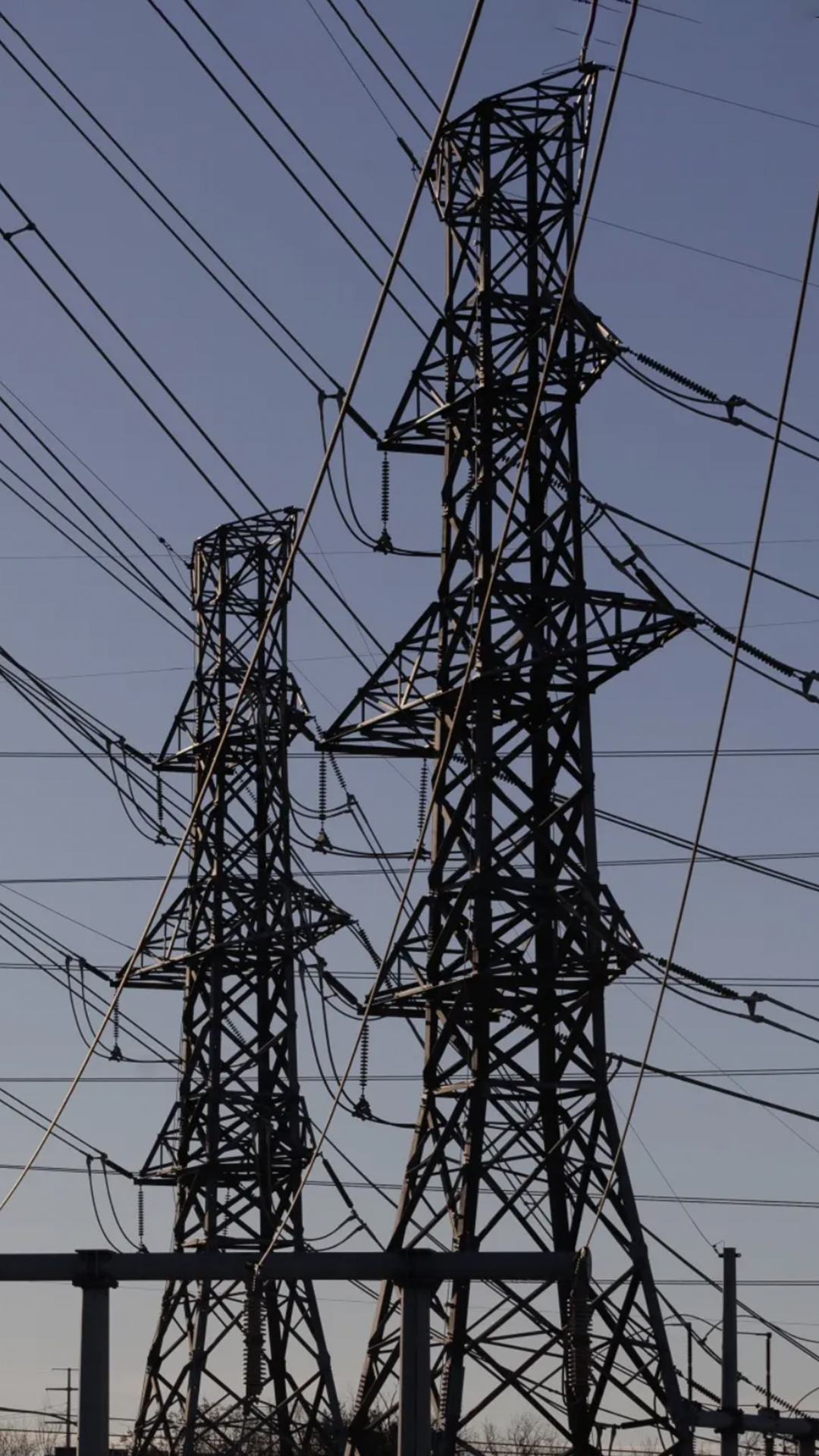
The Midcontinent Independent System Operator, which oversees the grid for more than 45 million people from the Great Lakes to the Gulf Coast, planned to shift into conservative operations late Friday.
MISO early Saturday declared a “level two emergency” for northern and central parts of the grid through 11 a.m. EST. Steps taken in response could include a public appeal to conserve energy, and possible emergency demand curtailment.
Meanwhile, PJM Interconnection, which stretches from Illinois to the East Coast, is set to operate on a more cautious and risk-averse footing starting Saturday.
The PJM region is home to the highest concentration of data centers in the US and is the focus of concerns over how electricity generation can keep pace with the AI-driven demand boom. US Energy Secretary Chris Wright urged companies to make backup power available from facilities including data centers.
Natural gas prices surged this past week, with front-month futures rocketing by more than 70% to more than $5 per million British thermal units.
The physical market, where gas is bought and sold for immediate delivery, was even more volatile, with prices touching $75 on Williams Co.’s Transco pipelines serving the Carolinas, Baltimore and New Jersey, and $100 in the Pennsylvania-New Jersey area, according to traders.
(Updates with MISO level 2 emergency in 27th paragraph.)
©2026 Bloomberg L.P.








