

French Power Glut Sends Spring Prices to Lowest Since 2020

(Bloomberg) -- French electricity prices fell to their lowest level in six years as a growing supply glut leaves the country struggling to export excess power in the coming months.
Contracts for delivery in the next quarter fell to as low as €21.10 a megawatt-hour on the European Energy Exchange AG, the weakest level in six years. Prices in Spain are also sliding sharply as surging wind and solar generation floods the grids.
France typically produces more electricity than it consumes, thanks largely to its extensive nuclear fleet. That surplus is now set to widen further, analysts say, driven by strong reactor availability, record renewable output and well-stocked hydro reservoirs. At the same time, export capacity remains constrained and industrial demand has yet to fully recover to pre-pandemic levels.
The imbalance is expected to keep wholesale prices depressed well into the summer. While lower power prices benefit households and energy-intensive industries, they are weighing heavily on generators’ earnings. Electricite de France SA warned earlier this month that profits are likely to decline as weaker market prices erode revenue.
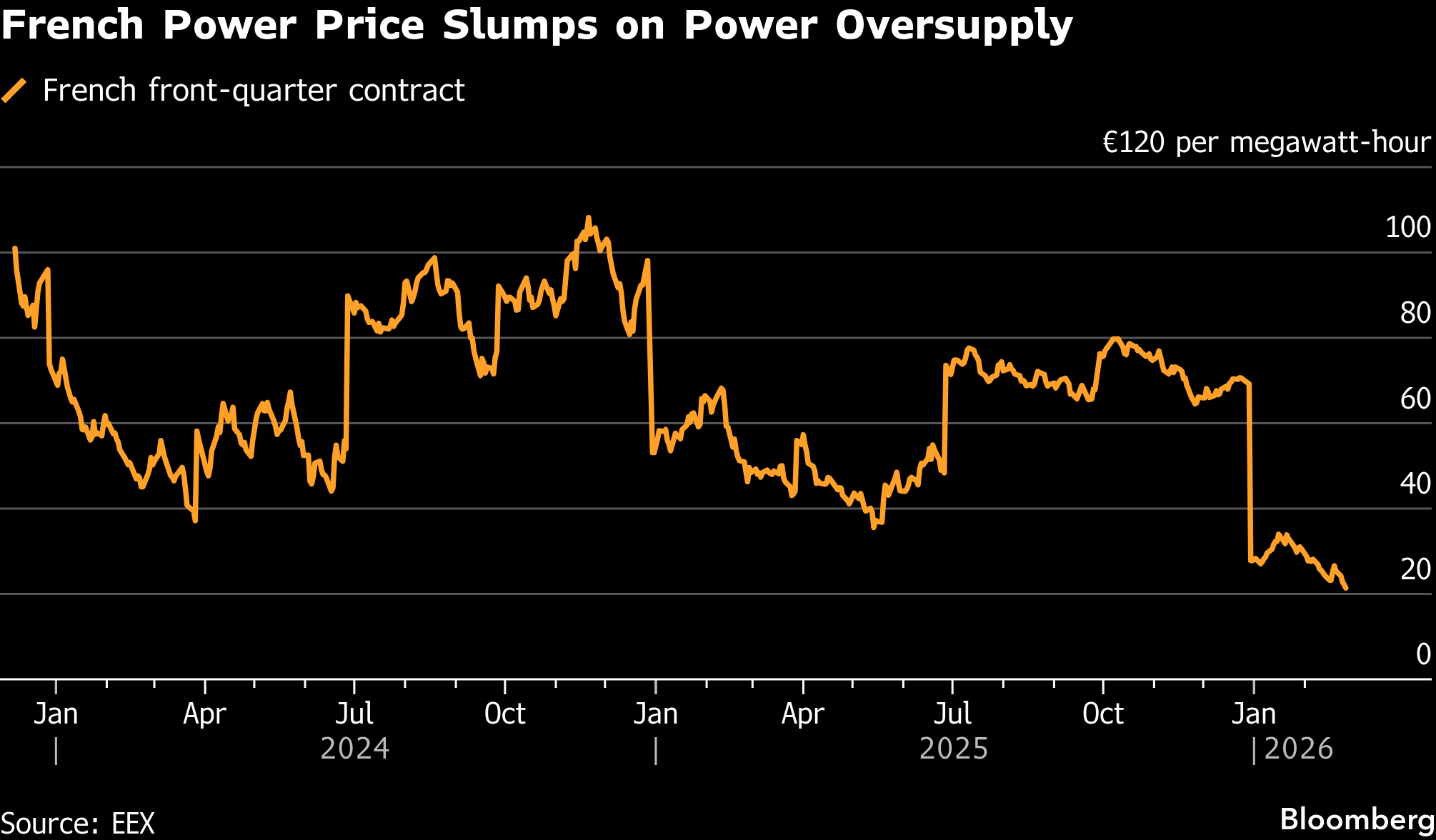
With February not yet complete, wind and solar generation for the month is already at the highest ever, according to the Fraunhofer Institute. French reservoirs are also well stocked following recent flooding, according to data from grid operator RTE. The nation recorded rainfall of almost 400% above the 10-year average so far in February, according to data compiled by BloombergNEF.
Meanwhile, electricity demand is expected to ease further as temperatures rise in spring, reducing heating needs. That combination of high supply and softer consumption could push prices toward zero — or below — during some hours.
“We expect a very high proportion of very low and negative prices in France,” said Nathalie Gerl, lead power analyst at the London Stock Exchange Group. “Many hours will end up in the range of €-10 to €10 per megawatt-hour.”
Explainer: Why Power Prices Can Go Negative and What It Means
When prices turn negative, producers effectively pay to keep generating, a sign that supply significantly exceeds demand. As a result, France is likely to see more curtailment, the temporary shutdown of renewable plants for economic or grid-stability reasons, according to Michael Schrettle, an analyst at Volue.
Its nuclear fleet is also expected to ramp down output more frequently than in previous years, according to Gerl. It becomes less economical to run reactors at full capacity during periods of extremely low prices.
A similar dynamic is unfolding in Spain. Robust wind and solar output, combined with hydro reservoirs that are above the recent five-year average, have pushed Spanish wholesale electricity prices to record lows. The country’s hydrological potential — a measure of water available for power generation — is at a 10-year high, according to Gerl, with further inflows expected as mountain snow begins to melt.
Spain’s average day-ahead power price fell to €16 per megawatt-hour so far in February, the lowest on record for the month, according to OMEL data.
With supply in both France and Spain outstripping domestic demand, attention is turning to cross-border flows. Expanded exports could help absorb some of the excess generation and lend support to prices.
“France’s export capabilities will be key in determining French day-ahead prices in the second quarter,” said Sabrina Kernbichler, an analyst at Energy Aspects Ltd.
©2026 Bloomberg L.P.








