

Trump Administration’s Geothermal Push Gets Big Test in Utah Desert


(Bloomberg) -- The future of geothermal energy, a renewable source that has charged up conservatives and liberals alike, is being charted in a scrubby patch of sagebrush, halfway between Las Vegas and Salt Lake City.
That’s where a federally funded field laboratory just began a vanguard test that may show whether fracking techniques used to produce oil can also tap underground heat to produce energy.
At the moment, there are scant places around the globe with the right properties to generate geothermal electricity; the current test, however, could make a case for geothermal plants virtually anywhere.
Kristie McLin, manager of Utah FORGE, the Energy Department field laboratory, said she was excited and nervous as her crew starting pumping water into the ground. “It’s butterflies really,” she said. “With geothermal technology, we have seen that initial liftoff and we’re advancing significantly what we can do economically.”
A new era for geothermal
The new drilling techniques are expensive, the industry is still tiny and the sole public player, Fervo Energy Co., has had a chilly reception on public markets.
However, if the new strategies work, the upside is immense, proponents say — a gusher of electricity that is cheap, constant and nearly emission-free. And while the Trump administration has severed federal support of solar and wind farms, it is still spending to try to make green energy happen in the Utah desert.
Geothermal energy is nothing new; engineers have been tapping the Earth for steam for decades, but only in relatively rare regions where they could find underground reservoirs of water. At the moment, there are about 100 geothermal plants in the US, supplying somewhere around 0.4% of the country’s electricity.
Recently, however, engineers and entrepreneurs have started working on a new approach: using the same drilling techniques for oil and gas fracking to create underground reservoirs where there were none. Water pumped down the well expands little cracks in the rock and then returns to the surface via another well, a so-called closed-loop system, essentially a subterranean steam plant that can spin power turbines up top for extended periods of time, if not indefinitely.
From pilot to potential
FORGE, which stands for Frontier Observatory for Research in Geothermal Energy, was launched during the Obama administration, primarily to test the thesis. More recently, Fervo and other startups have joined the push.
Preliminary tests from FORGE and Fervo, which has drilled in the desert nearby, were promising. The goal, according to McLin, is to make geothermal energy possible pretty much anywhere the Earth burbles at 200°C within five or so kilometers of the surface. This would put much of the American West on the map for geothermal electricity, theoretically precluding a host of new fossil fuel plants.
But McLin and other scientists have a few concerns. The test at FORGE, which may last up to four months, is designed to figure out if the regurgitated water will stay hot for an extended period or cool to the point where it won’t generate electricity. Scientists also fret over whether all the drilling and pumping will trigger earthquakes and how much water will be lost in the process, a sensitive issue given the extended drought in much of the American West.
Growing geothermal potential in the US
“There’s potential,” said Annick Adjei, a senior research analyst at Wood Mackenzie, an energy analytics firm. “But the risk is really in repeatability. We need a bit more in the way of milestones to see how things will go.”
While there are geothermal hotspots around the world, namely in Iceland and Kenya, the US has two critical ingredients: an abundance of open space and a glut of fracking know-how. The Energy Department reckons there’s enough potential geothermal energy to power the country five times over.
Perhaps because of those things, geothermal is arguably the only renewable energy technology garnering widespread bipartisan support. Since 2020, the government has committed $328 million to FORGE and the Trump administration has kept incentives for geothermal largely intact.
In part because of that funding, the cost of building new geothermal capacity in the US is now on par with other renewable sources and cheaper than coal plants, offshore wind farms and nuclear, according to a recent report from Lazard Inc.
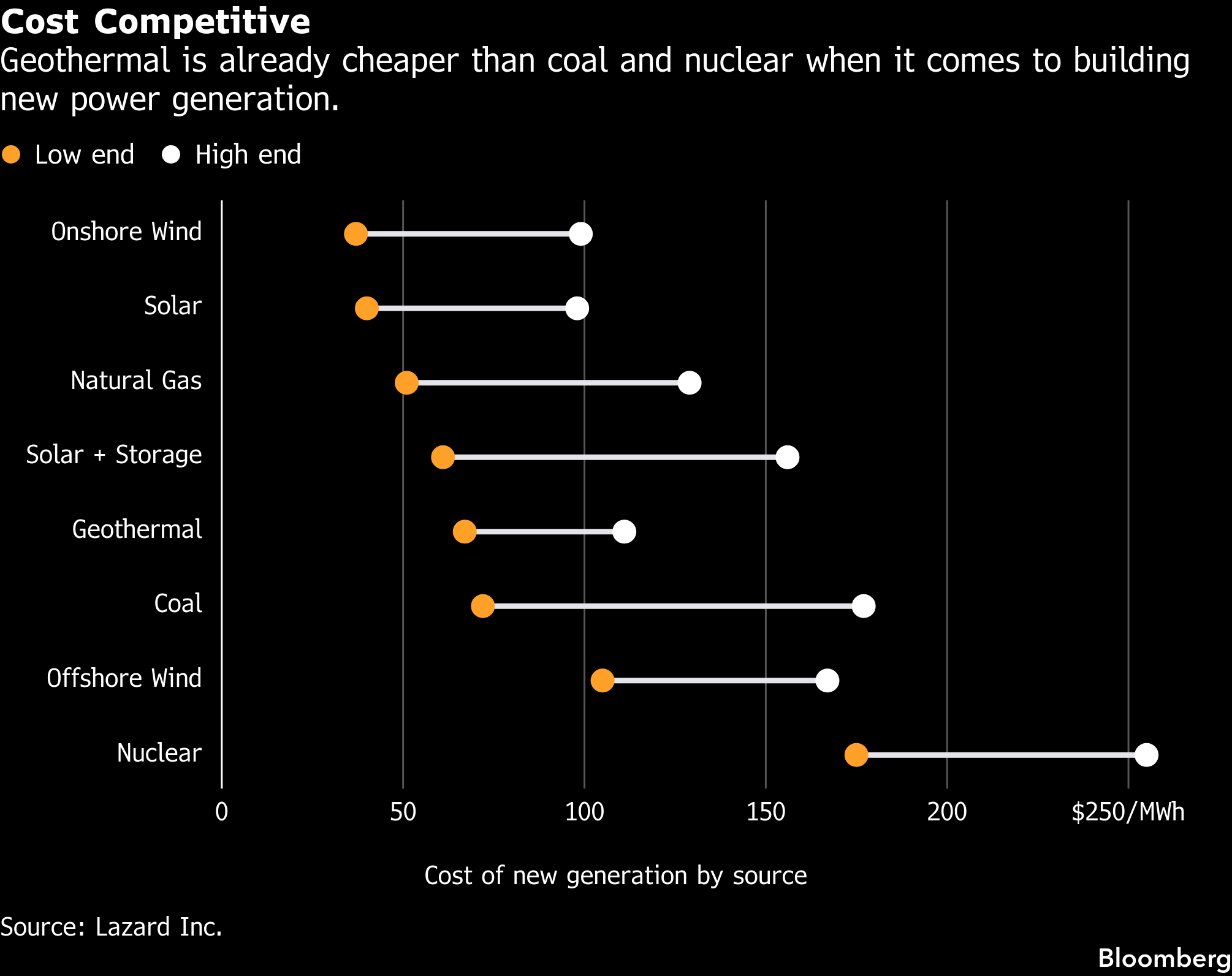
The AI boom, meanwhile, has improved economics on the demand side, as developers hustle to lock up pretty much any power generation they can get. Geothermal is a less volatile source than solar and wind, a major plus for those in the business of running large language models 24 hours a day.
Fervo already has an agreement to feed power to Alphabet Inc., though it doesn’t expect to generate any geothermal electricity in Utah until the fourth quarter. Its shares have fallen by nearly 40% since it went public in May on fears revenue may lag expectations.
“Anyone that wants to wait around for other project results is going to find themselves in a very disadvantaged position,” Fervo CEO Tim Latimer told analysts. “Because we have a huge set of customers who are certainly not waiting for any other additional milestones on top of what we’ve already demonstrated.”
If the FORGE test goes well, McLin said focus will shift to drilling farther into the Earth — where temperatures are hotter — and more efficiently. “Being able to go deeper for cheaper is how I say it,” McLin explained. “Eventually, we could unlock geothermal to be everywhere.”
©2026 Bloomberg L.P.