

How China Built a Big Lead in Global Race for Batteries That Last for Days

(Bloomberg) -- China is quietly dominating yet another area of the global energy transition: long-duration energy storage.
Unlike conventional lithium-ion batteries that typically store power for four hours or shorter, long-duration energy storage, or LDES, can hold and release electricity for many more hours or even days. As intermittent renewables become a bigger part of the global power supply, LDES is badly needed to help balance energy supply and demand, and China is racing ahead of the rest of the world.
The world added a record 9.6 gigawatt-hours of new LDES capacity last year, a roughly 30% increase from 2024 levels, according to the report published Monday by BloombergNEF. Almost every project built in 2025 was in China, the report said. That’s despite Western economies hosting a number of well-funded startups, including Form Energy in the US and Canadian company Hydrostor.
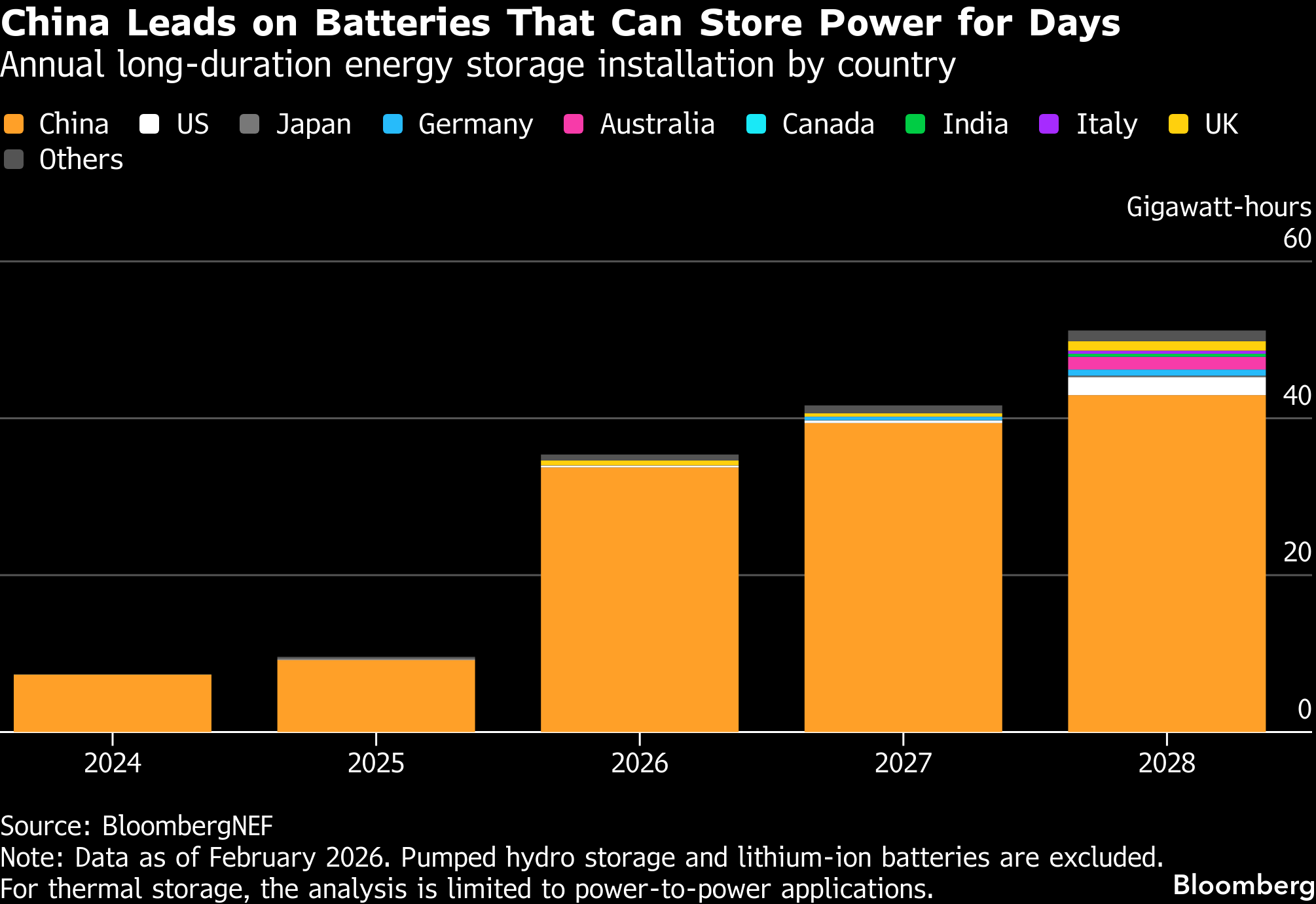
BNEF analysts attribute China’s lead in the sector largely to policy support. Beijing identified LDES as a crucial component of its net-zero roadmap in 2023. The following year, China’s energy regulator launched 56 pilot projects, which helped launch the current boom. The country has built a massive lead in other climate tech sectors as well, from solar panels to hydrogen.
There are 422 gigawatt-hours worth of LDES projects in the pipeline globally, of which 95% are planned for China. Just 2% of all planned projects are in the US, making it a very distant second. But there are signs the US is attempting to even the playing field: Form inked a deal to build out a 300-megawatt installation that will help power a data center run by Alphabet Inc.’s Google.
LDES represents a relatively small portion of the overall energy storage market, which saw roughly 247 gigawatt-hours of new capacity installed last year, according to BNEF. Most of that was lithium-ion batteries.
But “long-duration systems allow grids to shift large volumes of renewable energy across longer timeframes,” said Meredith Annex, head of clean power research at BNEF. “That’s why deployment is accelerating sharply.”
On the Wire
A raft of Chinese oil companies cautioned investors about risks stemming from sharp gains in their shares, warning that oil price swings remain highly uncertain.
China’s leadership is meeting in the shadow of crises abroad this week, as it puts the finishing touches on its blueprint for growth through 2030 and unveils plans to insulate the economy from global turmoil.
What’s the hot new thing in the solar industry? Double-sided panels? Flexible modules? Photovoltaic fencing?
MMG Ltd. said profit more than tripled last year, buoyed by higher commodity prices and strong output at key mines, though still fell short of analyst estimates.
This Week’s Diary
(All times Beijing)
Wednesday, March 4:
- Chinese People’s Political Consultative Conference begins in Beijing
- China’s official PMIs for Feb., 09:30
- MMG earnings webcast, 09:30
- RatingDog’s China services & composite PMIs for Feb., 09:45
- CSIA’s weekly polysilicon price assessment
Thursday, March 5:
- National People’s Congress begins in Beijing
- Premier Li Qiang delivers government work report at opening ceremony
- CSIA’s weekly solar wafer price assessment
Friday, March 6:
- China’s weekly iron ore port stockpiles
- SHFE’s weekly commodities inventory, ~15:30
Saturday, March 7
- China’s Feb. foreign reserves, including gold
(Updates to add details of week’s China events.)
©2026 Bloomberg L.P.