

A Global Nuclear Power Renaissance Isn’t Living Up to the Hype

(Bloomberg) -- Nuclear power is winning support from tech companies, utilities and governments seeking carbon-free, round-the-clock energy to fuel an artificial intelligence boom. In October, the Trump administration added fresh impetus — advancing an $80 billion plan to subsidize new facilities and fast-track experimental designs.
And yet in much of the world — from the US to France, Europe’s nuclear powerhouse — those lofty ambitions are at odds with the reality of an industry hollowed out by decades of stagnation.A Bloomberg News analysis of company announcements, construction pipelines and industry forecasts suggest the current push comes too late to stop China’s nuclear capacity from overtaking the US fleet at the start of the next decade. Today, the US is the biggest producer of electricity from splitting atoms, but its output will plateau over the next decade. Others, like Japan, are struggling to maintain their capacities.
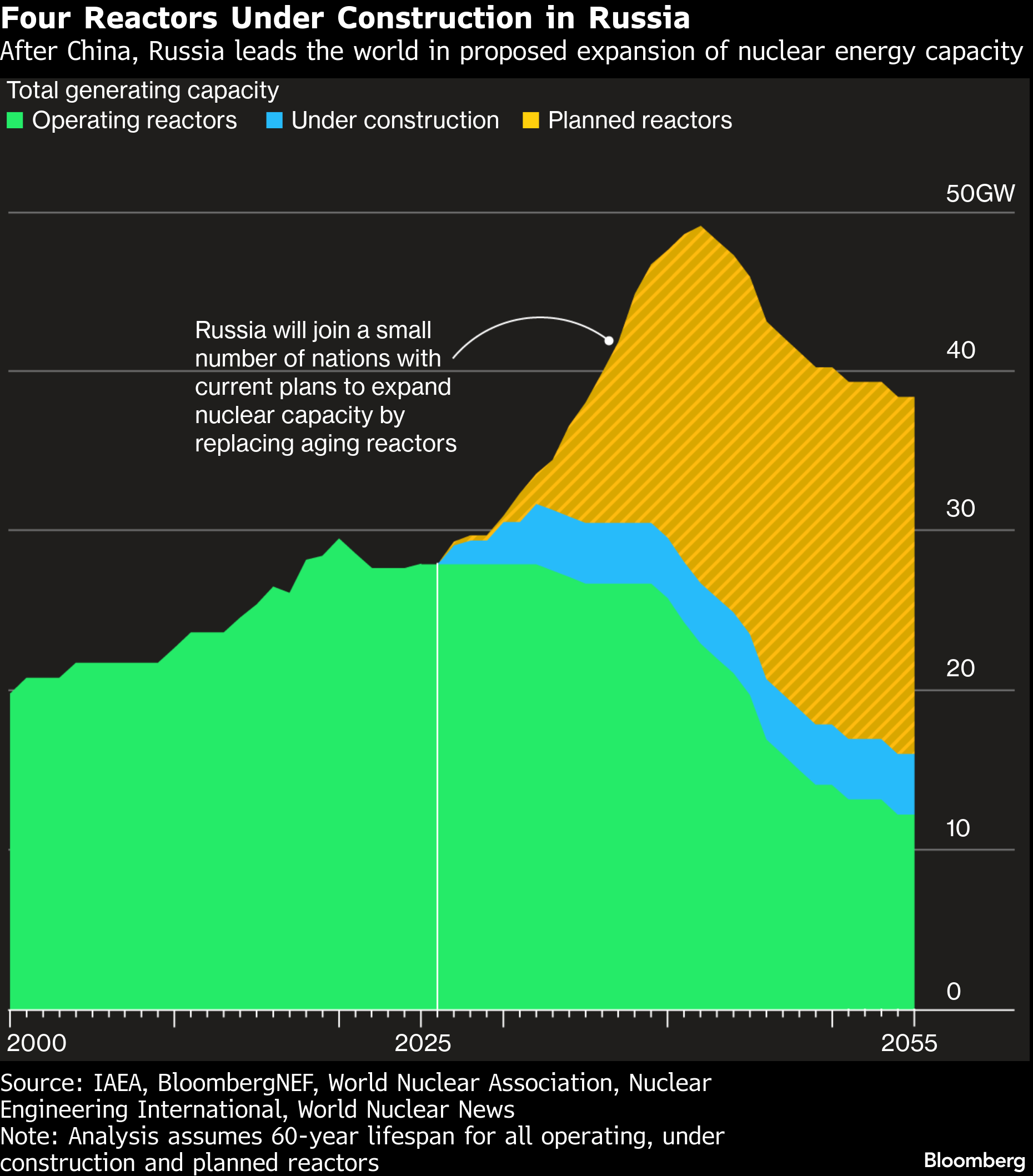
China stands in stark contrast. It’s building reactors at an unprecedented pace — as many as 10 units a year — backed by state financing and a homegrown supply chain, as it pursues energy security, cleaner air and technological dominance. If current construction plans and projections hold, it will overtake the US’s capacity by 2032, the data show.
That could give Beijing a crucial advantage in the scramble for the energy needed to gain an edge in power-intensive artificial intelligence.
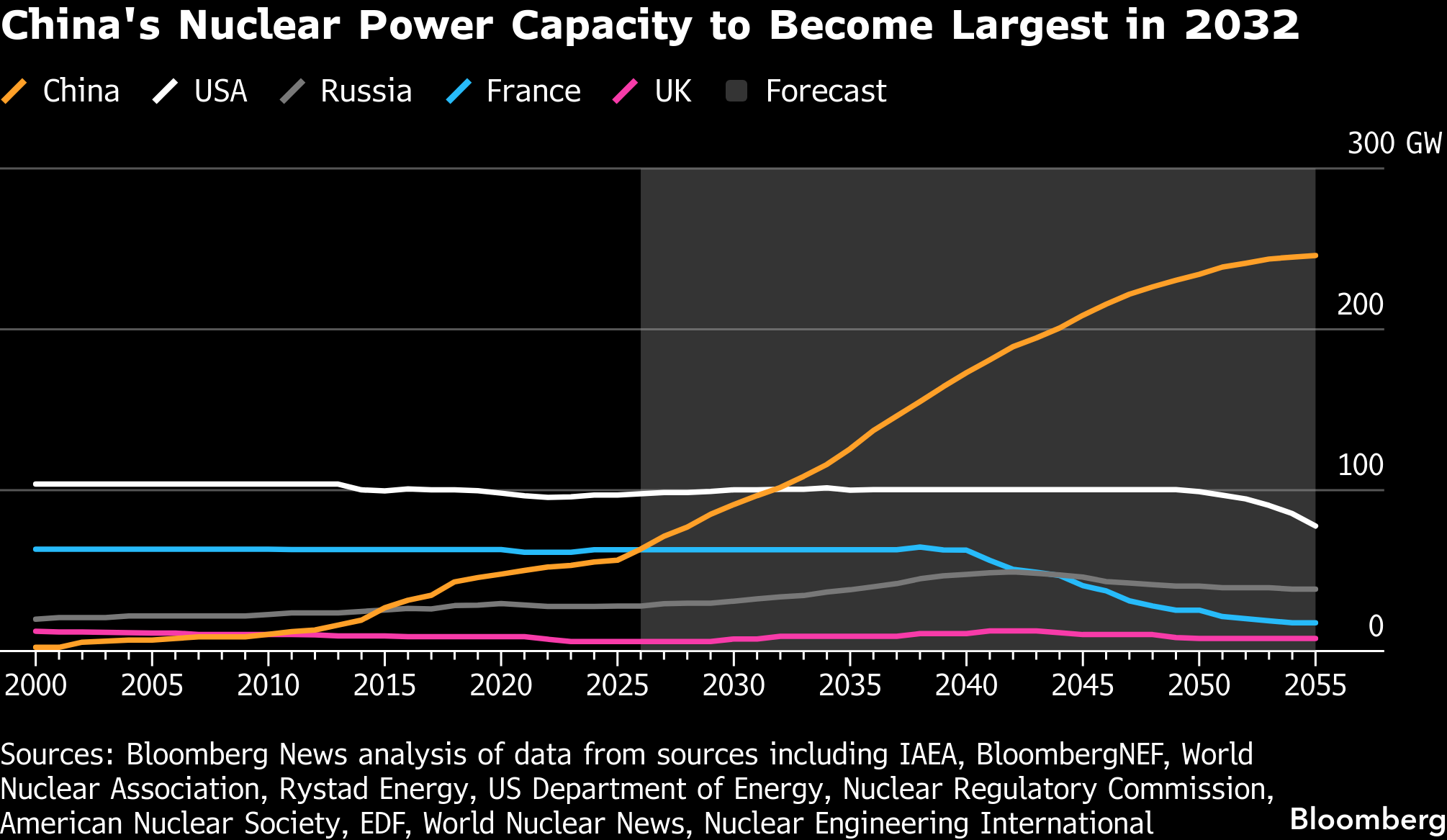
Thanks to decades of making the technology a priority — plus helpful regulation, financing support and a plentiful workforce — China is now able to build reactors at less than a fifth of the cost in US and Europe, according to BloombergNEF. Meanwhile, projects in developed nations have been plagued with delays and cost overruns. Vogtle in Georgia, the first new US plant in three decades, was completed in 2024, years behind schedule and at more than double the original estimated price.
“Vogtle barely limped across the finish line, over budget and behind schedule. This was the critical inflection point,” said David Fishman, a Shanghai-based principal at energy consultancy The Lantau Group. “That was the moment where economic actors in the US completely lost faith in their ability to build new nuclear domestically. That was the moment where the risk of importing and building US nuclear technology would have started to look quite overwhelming for potential customers globally.”
Failure to Launch
The US has long been at the forefront of nuclear developments. The first reactor was built on American soil. There were consequential breakthroughs from labs in New Mexico, Tennessee and Idaho. Countries lined up to secure the newest source of electricity.
The promise of atomic energy — virtually limitless power without the need for costly fossil fuel imports — propelled a world-leading buildout of the technology through the 1960s and 1970s in the US. That momentum was derailed by the Three Mile Island accident in 1979, which resulted in a partial reactor core meltdown.
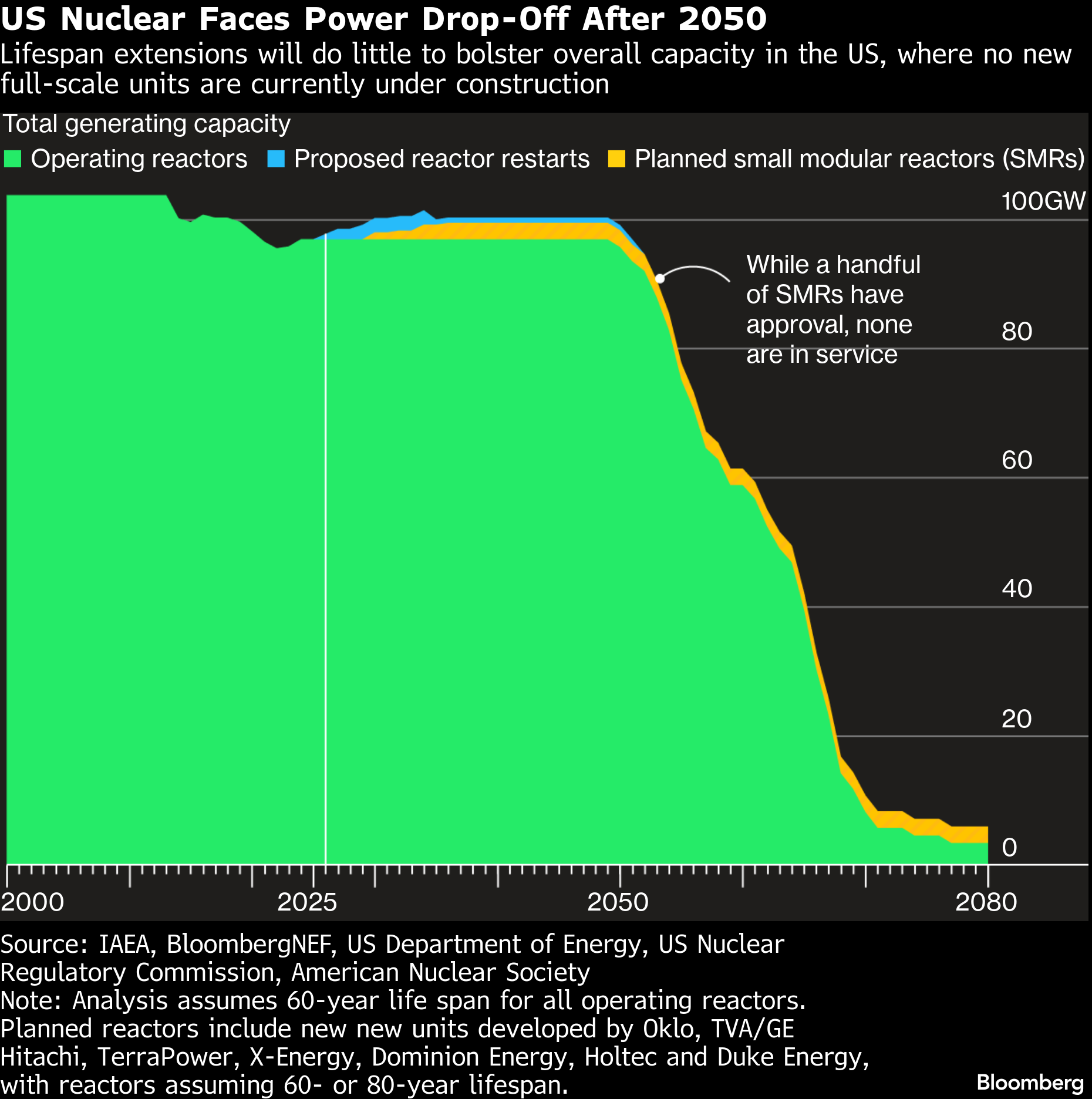
Today, the US has 94 reactors, with an average age of 44 years — past the typical lifespan of four decades that the license authorizes. Most operators renew their permits for an additional 20 years, and with many seeking approval for the second time, the generating units can typically run for as long as 80 years. The Trump administration’s executive orders have sought to expedite small modular and advanced reactors, newer technologies that are expected to form the backbone of new construction. Yet none have started full-scale building. While dozens of firms have plans for small modular reactors, only one has design certification — NuScale Power Corp. In the near term, America’s only solution is to run its existing fleet for longer. There are plans and proposals to reopen plants that have been closed— most famously Three-Mile Island, which will provide Microsoft Corp. with carbon-free electricity.
Strong Government Backing
The countries where the outlook for nuclear is the strongest have two things in common: government support and a domestic industry that has been building plants non-stop for decades, accumulating expertise.China has 33 reactors under construction and in April approved a 200 billion yuan program ($29 billion) to add a further 10. In comparison, the US has connected just three this century.
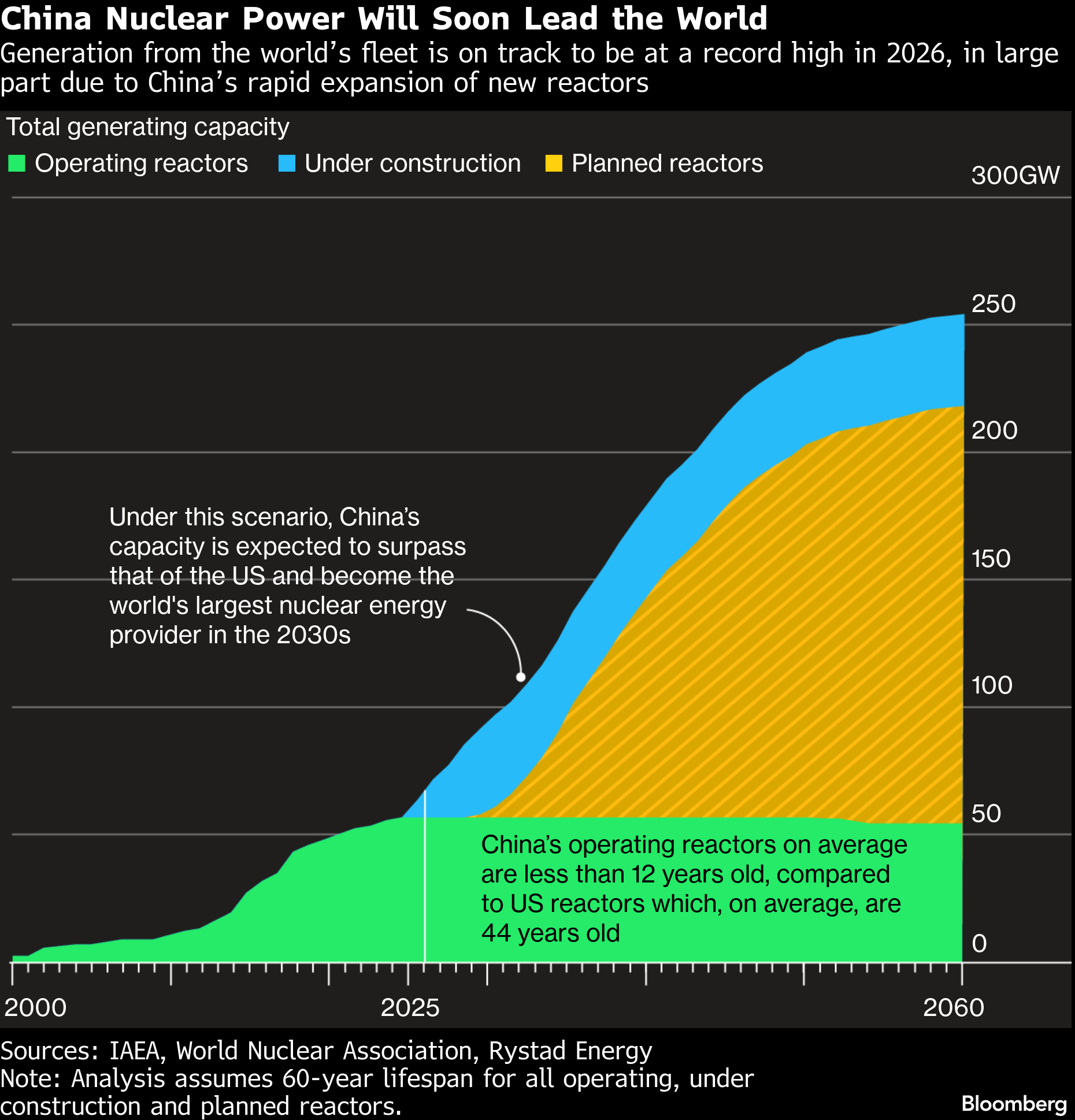
Russia, despite the travails of its atomic program after the Chernobyl disaster and the collapse of the Soviet Union, is replacing aging units. Its war in Ukraine has choked state-run Rosatom Corp.’s funds to expand at home and abroad, but the company has lofty goals to as much as double generation capacity over the next few decades.
India, meanwhile, has joined the race in earnest, opening up the sector to private companies. New Delhi wants to add 100 gigawatts of capacity — an ambitious goal that would mark an 11-fold rise from current levels and could require $211 billion of investment — by 2047, the year it seeks to attain developed-nation status.
Technological Hiccups
In more established economies, the major hurdle has been execution. Electricite de France SA, Europe’s flagship builder, has struggled to deliver projects on time and on budget. Many of those challenges echo the US experience and have similar causes: after Chernobyl, new construction slowed sharply, eroding expertise and hollowing out the industrial base needed to deliver large-scale projects efficiently.
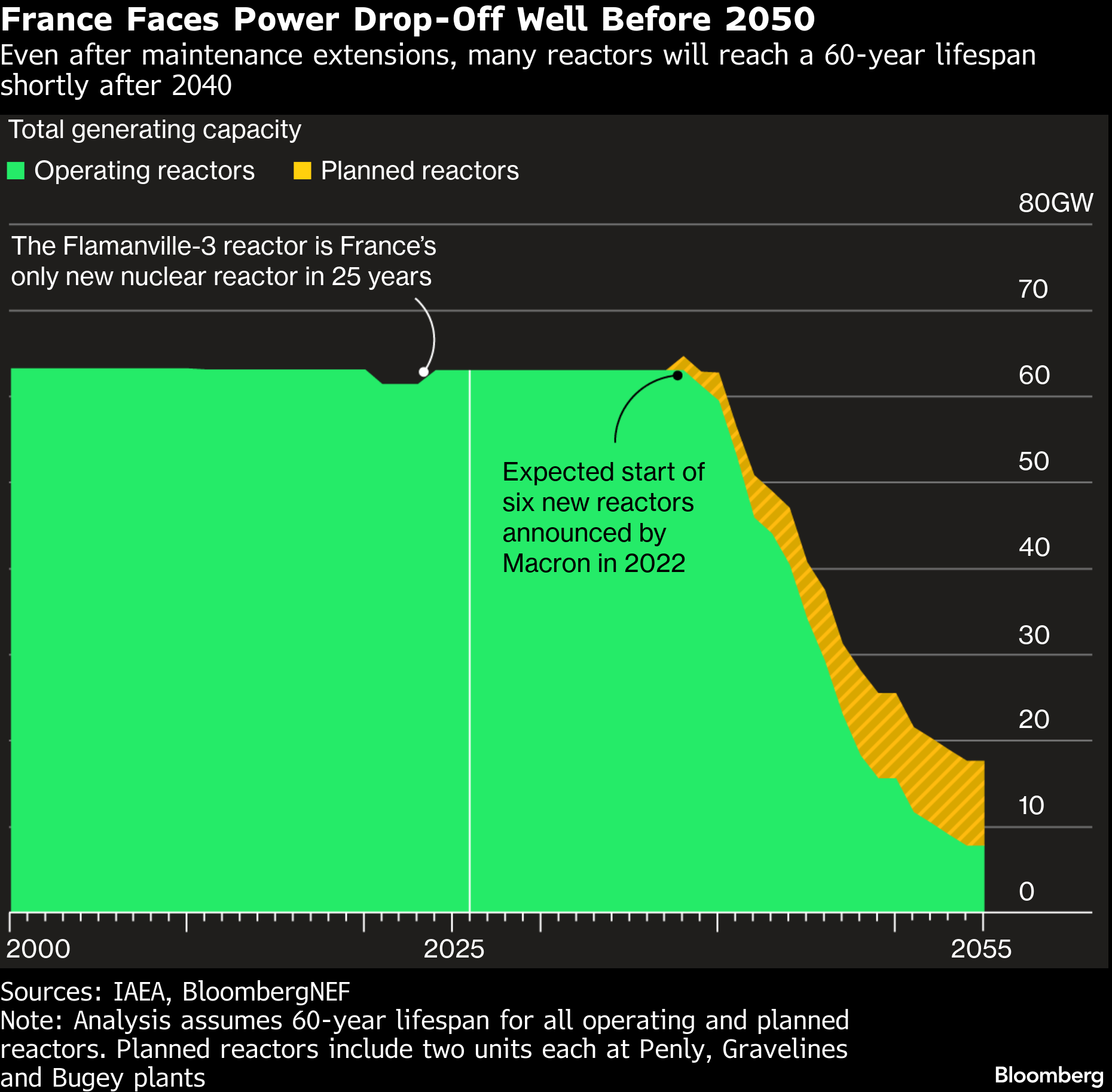
France has traditionally been a heavy used of atomic power and has one of the world’s largest fleets. Nuclear made up 70% of the European nation’s power mix in 2025, according to Ember.French President Emmanuel Macron has announced plans for six new units, but the target date for the first has already been pushed back three years to 2038. Even so, the projects will do little to replace an avalanche of planned retirements when facilities reach the 60-year mark.
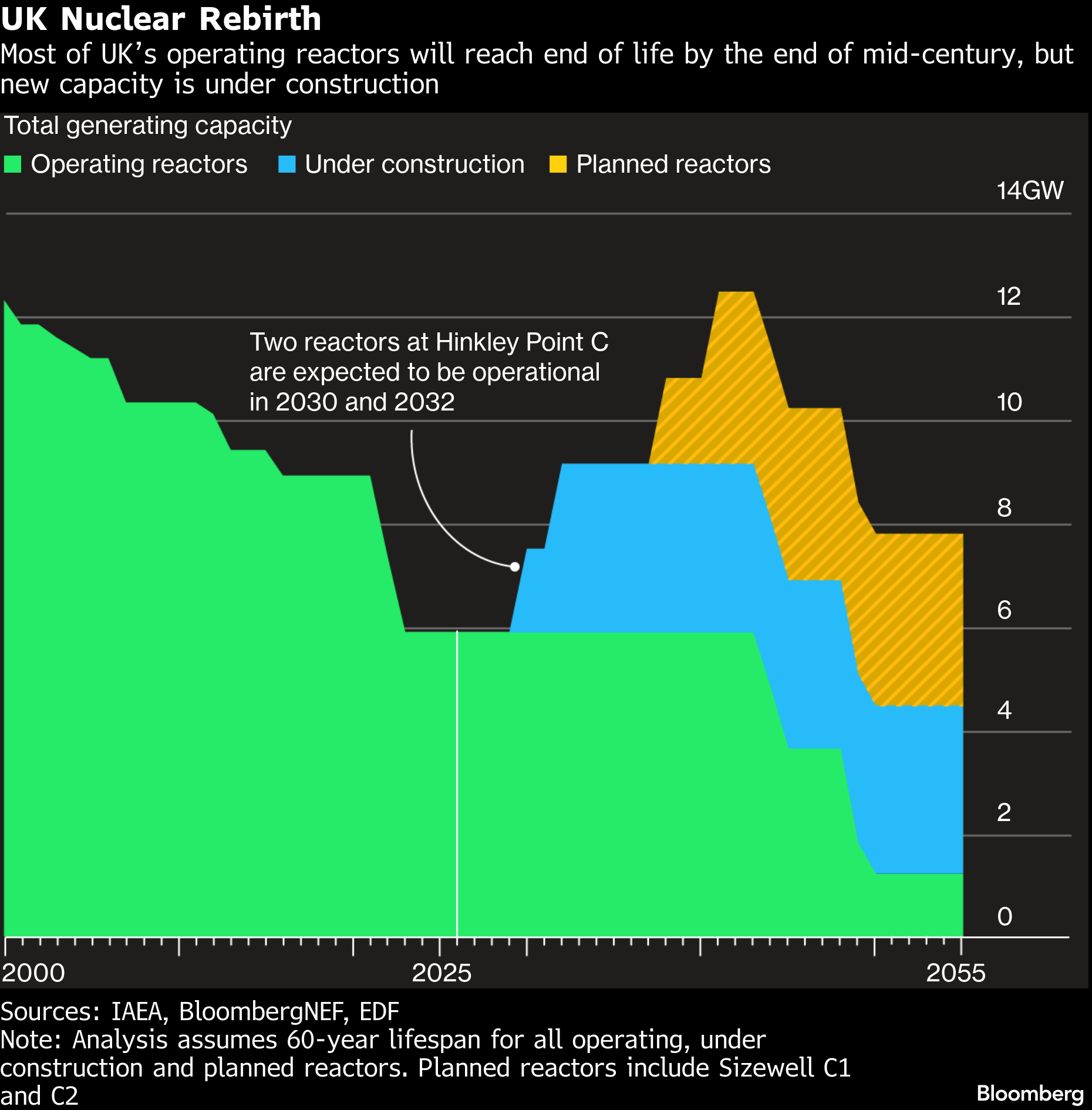
Across the Channel, the UK nuclear sector has steadily shrunk from a high mark at the turn of the century.
That decline could reverse if projects proceed as planned, but that is far from guaranteed. Hinkley Point C was supposed to begin operations last year, but has been beset by delays and cost overruns. Builder EDF most recently booked a charge on the project and pushed back the start date for the first unit by another year to 2030. Setbacks at Hinkley Point also threaten to increase the firm’s financing needs as it prepares to build new units in its home market.
Returning From Disaster
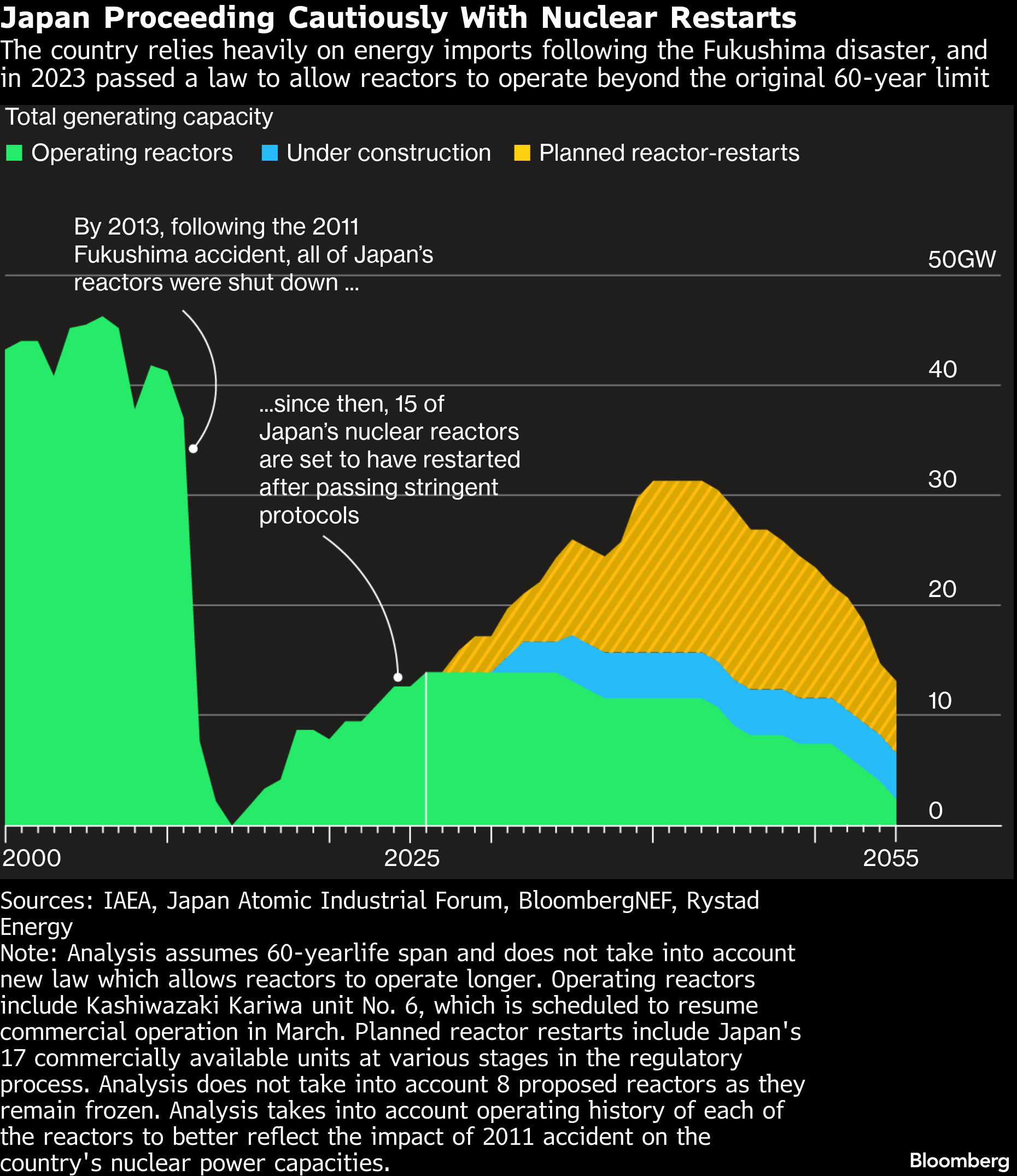
Japan — a resource-scarce nation which until the 2011 Fukushima disaster had ambitions for nuclear to provide 50% of its power — is pushing ahead with atomic energy again. However, new reactors will take more than a decade to come online, and even that depends on lengthy regulatory checks.
The nation took all of its units offline in the immediate aftermath of the accident. Since then, only 14 of the 33 commercially available plants have managed to restart under stringent protocols. One more reactor — at Tokyo Electric Power Co.’s Kashiwazaki Kariwa — is expected to resume commercial operation this month.
Future Prospects
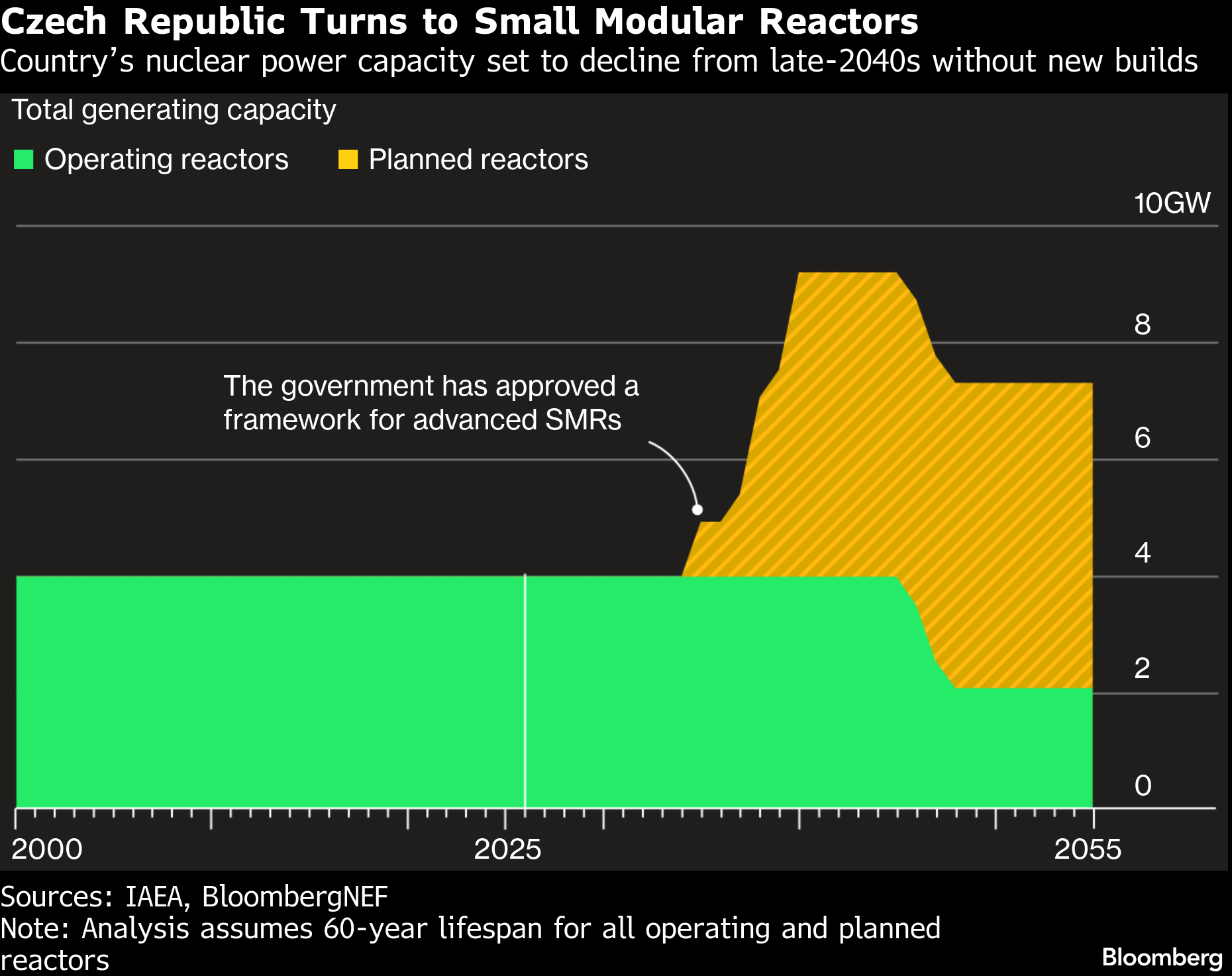
Smaller economies are also embracing the technology. Recent policy changes in Belgium will enable the country to have access to atomic energy into the 2040s. In the Czech Republic, Rolls-Royce Holdings Plc is exploring a partnership with the nation’s utility to deploy up to 3 gigawatts of its small modular reactor.
More than 70 years since the first production of electricity from the splitting of atoms, the technology remains attractive, mainly because it can produce around-the-clock power without burning fossil fuels and emitting carbon dioxide. However, as the costs of wind and solar continue to decline — making them the cheapest source of new generation in most nations — a global nuclear renaissance will be heavily dependent on government support and the willingness of technology giants to pay a premium to ensure continuous supply to their data centers.
©2026 Bloomberg L.P.








