

Europe Widens Its Lead Over US, Asia in Switch to Cleaner Jet Fuel


(Bloomberg) -- When it comes to cleaner jet fuel, the stick is proving mightier than the carrot.
European airlines surged ahead in their use of sustainable aviation fuel, or SAF, last year, while carriers in the US and Asia fell further behind, according to a Bloomberg News analysis of dozens of airline environmental filings.
British Airways’ parent company IAG SA led passenger airlines with 3.3% of its jet fuel coming from SAF, followed by Air France-KLM at 2.9% and Ryanair Holdings Plc at 2.0%. US airlines, meanwhile, hovered between 0.3% and 1%.
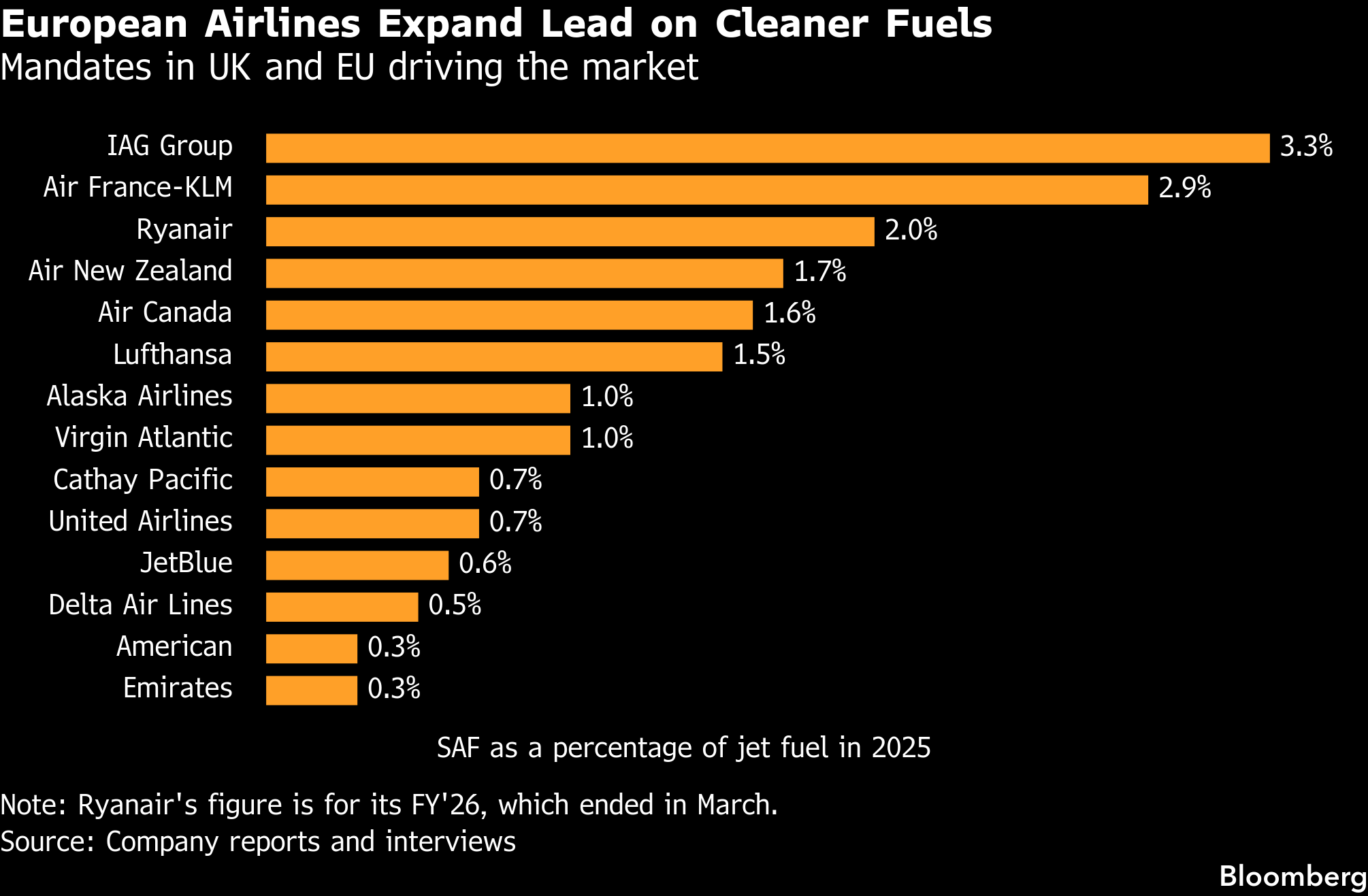
The growth has largely been driven by mandates in the EU and UK, which kicked in last year and require 2% of jet fuel to be SAF. That obligation steps up to 3.6% this year in the UK.
The US, by contrast, has shied away from SAF mandates amid opposition from airlines. Federal and state governments instead offer financial incentives to boost production. But with cleaner jet fuel costing two to three times as much as conventional fuel, voluntary demand has remained weak.
“The numbers show that the mandates work,” said Camille Mutrelle, aviation policy manager at Transport & Environment, a nonprofit in Brussels.
IAG alone purchased more SAF last year than all US airlines combined. The owner of British Airways, Aer Lingus and Iberia bought more than 99 million gallons, compared with about 97 million gallons consumed by major US carriers, according to industry group Airlines for America.
The group, however, says the market is still too immature to conclude that mandates work far better than voluntary efforts. It also points out that SAF consumption in the US more than doubled last year.
“We’ve seen an incredible amount of progress in the US despite all the challenges in the market,” said Kevin Welsh, Airlines for America’s vice president of environmental affairs.
When including logistics and delivery companies, Germany-based DHL Group leads the planet with 10% of its jet fuel coming from SAF.
Europe’s gains mask a slower global shift. SAF consumption doubled worldwide last year, yet accounted for just 0.6% of jet fuel. The International Air Transport Association expects that to rise to 0.8% this year as growth slows.
That tepid increase could undercut the voluntary pledges of airlines, with dozens promising to reach 10% SAF by 2030. Even with SAF expected to grow sixfold by the end of the decade, it will only account for about 3.5% of the world’s jet fuel, according to estimates from BloombergNEF.
Such expectations could climb, though, as more countries follow Europe’s approach. South Korea will require a 1% SAF blend for international flights departing the country starting next year, while Singapore will impose a levy on airline tickets to help fund purchases of the cleaner fuel. The Canadian province of British Columbia will introduce a 1% renewable-fuel requirement for jet fuel in 2028. Other governments, from Turkey to Indonesia, are also pursuing SAF mandates.
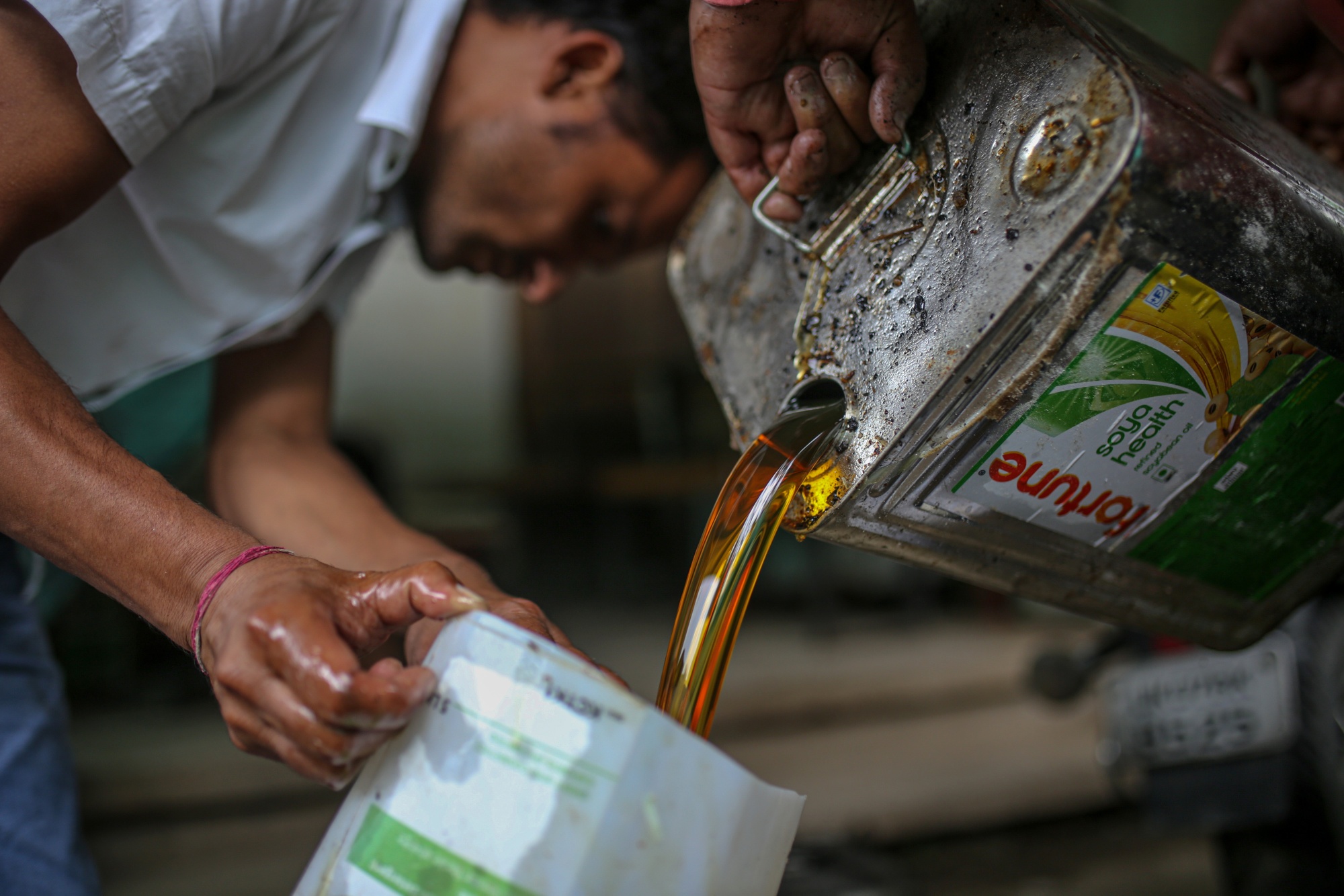
As SAF production ramps up, securing enough low-carbon feedstocks will be a big challenge. Much of today’s cleaner jet fuel is made from used cooking oil and animal fats, but supplies are limited. Environmentalists worry that surging demand could boost reliance on crops to produce the fuel, which could bring its own environmental costs, from fertilizer use to the clearing of forests and grasslands.
That’s why some green groups hesitate to use the phrase “sustainable aviation fuel” when describing these alternate propellants. “Sustainability has to be earned and demonstrated, not just assumed,” said Tim Johnson, director of Aviation Environment Federation, a nonprofit in the UK.
One highly anticipated solution is e-SAF, a next-generation fuel made using renewable electricity, hydrogen and captured CO2. It can cut emissions by 90%. But the technology remains in its infancy, with the fuel only available in “laboratory quantities” and costing up to 10 times more than conventional fuel, according to Lufthansa.
US startup Twelve opened one such facility in Moses Lake, Washington, in June. Even when operating at full tilt, the plant will only produce about 50,000 gallons a year – roughly the amount needed to fly a 747 from New York to London and back.
Twelve plans to develop much larger US plants capable of producing tens of millions of gallons annually, though it declined to disclose their potential locations or provide a more precise timeline.
With just a couple of other e-SAF plants under construction around the world, Mutrelle of Transport & Environment worries supplies will fall far short of what’s needed in the coming years.
“The situation is becoming more and more concerning,” she said.
©2026 Bloomberg L.P.