

Global Solar Growth Set to Slow for First Time, BNEF Says

(Bloomberg) -- Solar installations are set to slow next year for the first time since the industry emerged as a global force two decades ago, as policy shifts and saturation in major markets temper demand.
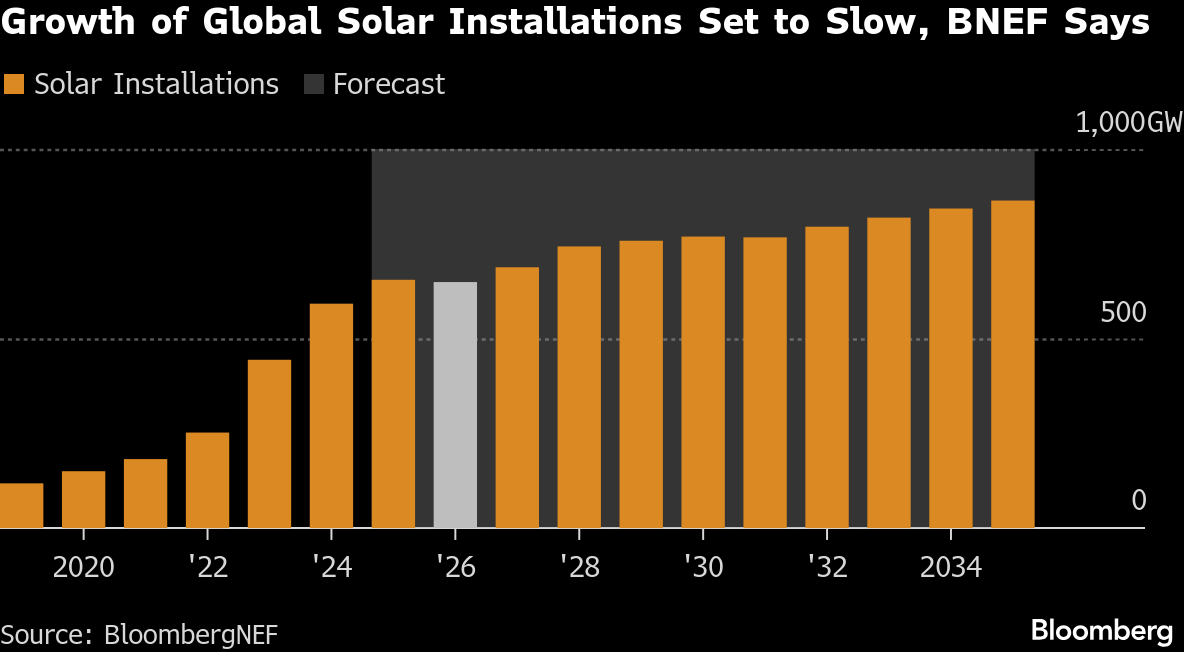
The world is set to add 649 gigawatts of solar power capacity in 2026, down slightly from 2025, BNEF’s Global PV Market Outlook showed. This year’s growth is the weakest in seven years, and next year’s contraction will be the first in records going back to 2000.
“The solar industry is entering a low-growth phase after years of rapid expansion,” BNEF said in the report. Driving the decline is a range of policy shifts in China and the US that have cooled demand growth, it added. Some other markets, though poised for strong growth next year, will not be able to offset the significant shortfall caused by the world’s two biggest economies.
This is particularly bad news for Chinese solar manufacturers already grappling with overcapacity and losses. A market-based pricing policy for renewables introduced in June prompted a rush of installations in the first half of this year and led to a sharp slowdown thereafter. BNEF lowered its 2025 installations forecast for China by 9%, to 372 gigawatts, followed by a 14% contraction in 2026.
The US market is also expected to slow at a similar rate due to President Donald Trump’s efforts to limit renewables deployment and pivot back to fossil fuels. Other mature markets like Spain and Brazil are also losing momentum. They’ve seen a rapid buildout of solar capacity that has led to increased curtailment and falling power prices, and created uncertainty that is beginning to suppress investment activity.
Prices across the value chain will remain stuck at historically low levels through 2026, with a weaker demand outlook and “an unprecedented amount of manufacturing capacity and inventory,” the report showed.
Polysilicon offers an example of the challenges. Prices of the key upstream material in China remain low overall, even as the sector’s consolidation efforts brought about a boost of 50% since June. The highly saturated sector will have limited room for significant price recovery as demand declines.
Still, solar installations are expected to see “modest” growth as early as 2027, as China and the US adjust to new supply and demand conditions and as new markets expand. Total installations for that year are expected at 688 gigawatts, BNEF said.
(Updates with tout.)
©2025 Bloomberg L.P.








