

US Evacuates Beirut Embassy Staff Amid Tensions, Iran Talks

(Bloomberg) -- The State Department ordered the evacuation of non-emergency personnel at the US embassy in Beirut on Monday, amid expectations that President Donald Trump could order airstrikes on Iran even with another round of diplomatic talks this week.
An assessment of the security environment in the region led the US government to reduce its footprint to only essential personnel, a senior State Department official said on condition of anonymity. The embassy remains operational and the measure is temporary, the official added, without mention of Iran.
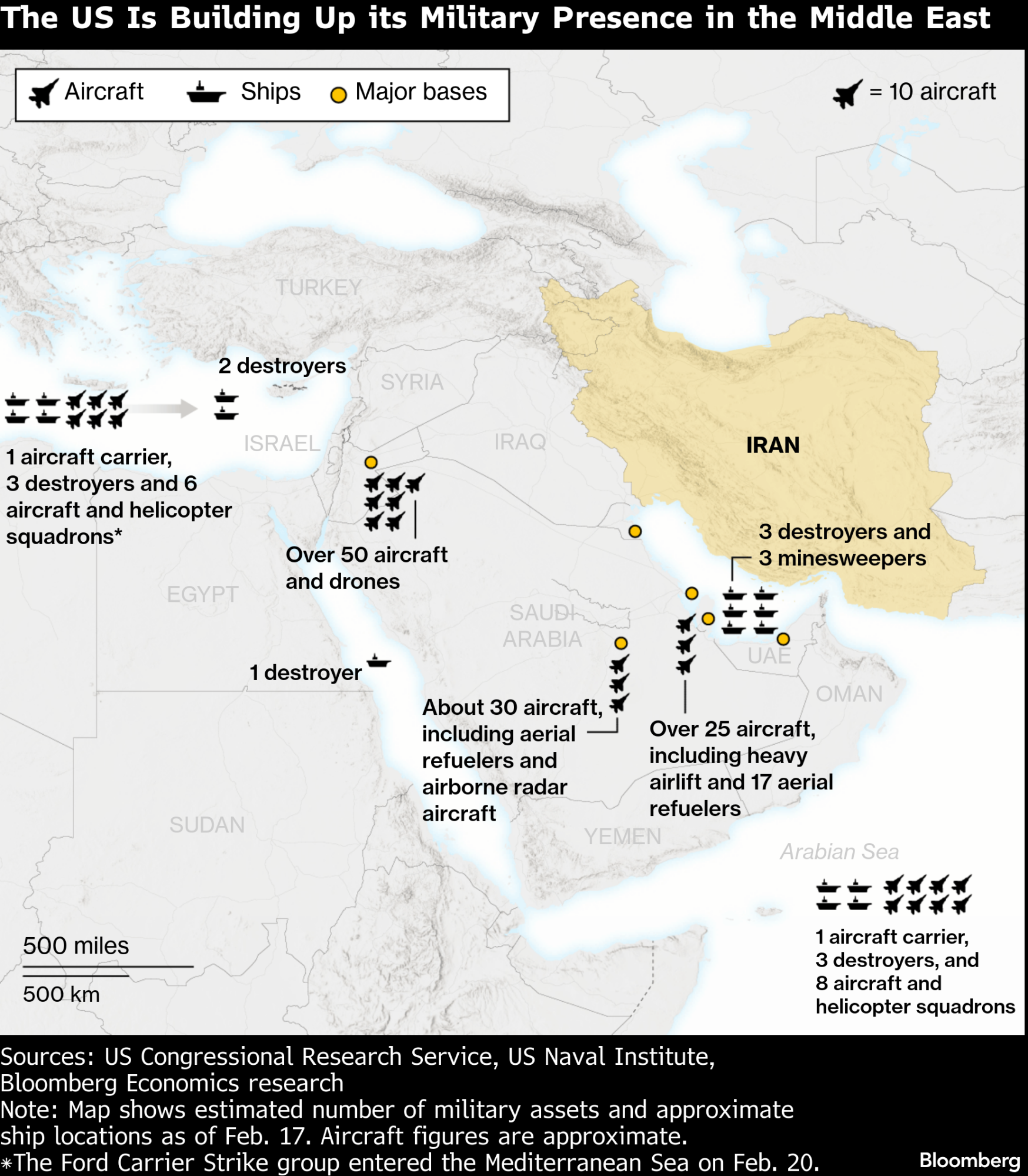
The US military is assembling a vast array of forces in the Middle East — likely the largest US deployment in the region since the 2003 invasion of Iraq — including two aircraft carriers, fighter jets and refueling tankers. Trump said on Friday that he’s “considering” limited strikes on Iran and has said Tehran has around two weeks to strike a deal over its nuclear program.
US and Iranian diplomats have been attempting to negotiate a new nuclear deal in recent weeks after Trump pressured Iran into participating with threats of military action.
The president’s special envoy Steve Witkoff and son-in-law Jared Kushner plan to travel to Geneva this week for a new round of US-Iran talks on Thursday, a US official said.
The two US envoys will meet once again with Iranian Foreign Minister Abbas Araghchi, who has repeatedly stressed the possibility of a diplomatic solution despite Trump’s threats.
“I believe that still, there is a good chance to have a diplomatic solution which is based on a win-win game and a solution is at our reach,” Araghchi said Sunday on CBS’s .
The ongoing talks have been punctuated by a massive US military buildup in the Middle East, renewed warnings of airstrikes from Trump and new US visa restrictions on Iranian officials over Tehran’s violent suppression of widespread domestic protests at the turn of the year.
Those protests were the original reason Trump gave for a potential US bombing campaign, but the president and other administration officials have offered conflicting public accounts of what they actually want from a new deal with Tehran.
Some officials, including Secretary of State Marco Rubio, have argued for a deal that includes Iran’s missile program, suppression of protests and support for proxy militant groups across the Middle East — including Yemen’s Houthis and Lebanon’s Hezbollah. Others, including Trump, have said a narrower nuclear deal may be enough.
While Trump said Iran had 10 to 15 days to agree to a deal, he may also decide to defy his own time frame, as he did when he ordered a previous round of US strikes in June 2025. He claimed at the time that “key nuclear enrichment facilities have been completely and totally obliterated.”
Trump could offer a fresh message on Iran during his State of the Union address on Tuesday. Witkoff said in an interview with Al-Arabiya that the US president is “curious” as to why Iranian officials haven’t “capitulated” to the increased US pressure by offering concessions on their nuclear program.
Iran experts have argued that bombing the country in the middle of negotiations might derail a deal. It could also prompt a deadly cycle of retaliation that includes pushing proxy groups to attack US military bases or facilities in the region. It’s possible fears of an Iranian or Hezbollah attack prompted the partial evacuation order at the Beirut embassy.
(Updates with additional details, context from fifth paragraph.)
©2026 Bloomberg L.P.








