

Raízen Hiring Advisers as Bonds Slump on Debt Concerns

(Bloomberg) -- Leia em português
Raízen SA’s credit rating was slashed deeply into junk grade by Fitch Ratings and S&P Global Ratings as the Brazilian sugar-and-ethanol company faces a growing cash crunch, fueling a selloff in its bonds that’s cut the prices nearly in half over the past week.
The deepening pressure on the company — which has so far been unable to raise additional funding from backers Cosan SA and Shell Plc — has led it to hire the consulting firm Alvarez & Marsal as part of an effort to shore up its finances, according to people familiar with the situation.
The speed of the turmoil engulfing Raízen, one of South America’s largest agricultural businesses, has driven the price of its bonds to distressed levels and is fanning worries about the strains on other companies that have raised money in Brazilian debt markets.
“This will be seen as a painful one,” said Ray Zucaro, chief investment officer at RVX Asset Management. “It has good shareholders and was investment-grade rating — so it’s a very quick unwind.”
Raízen was hit by unusually deep back-to-back downgrades by Fitch and S&P on Monday that knocked its debt from investment grade to well into junk-bond territory. Both kept the ratings on negative watch, indicating they could be dropped further.
Fitch cut its rating five levels to B, citing “shareholders’ failure to execute a material capital injection,” its weaker-than-expected operating performance and a “more challenging” liquidity position. S&P lowered its grade seven steps to CCC+, saying it sees “increasing risks of a debt restructuring that we would view as a default.”
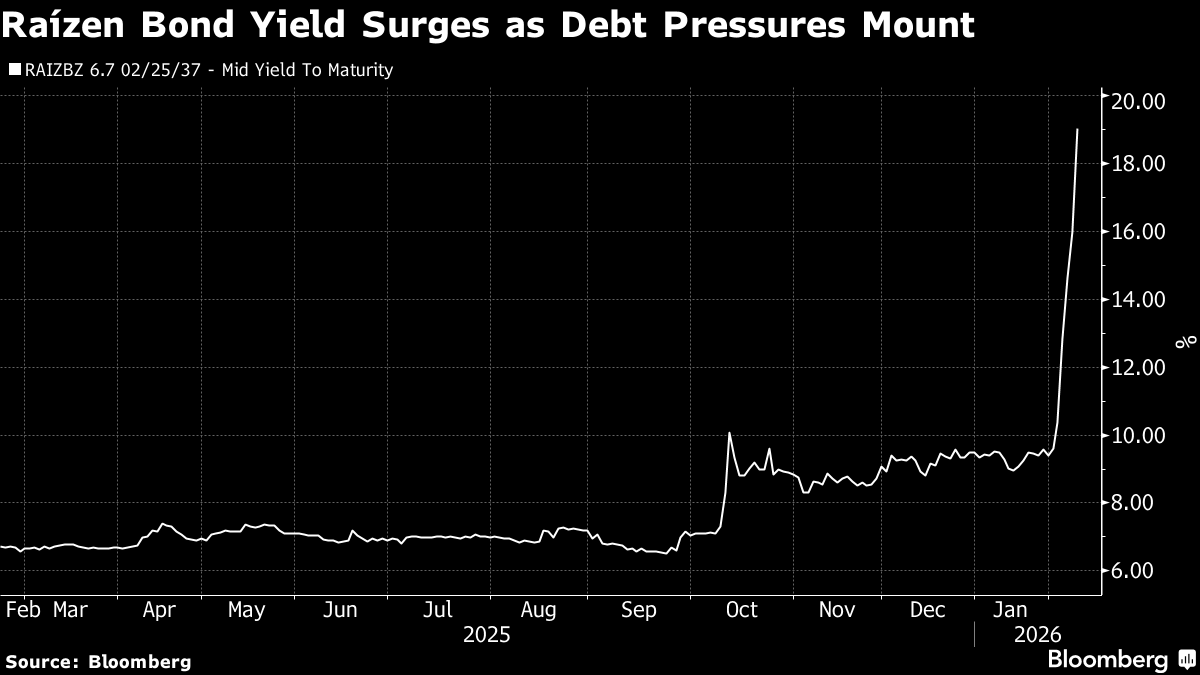
After the rating cuts, Raízen’s dollar bonds due in 2037 dropped about 8.5 cents to 43.9 cents on the dollar, down from over 80 cents a week ago. That pushed the yield over 19%, according to data compiled by Bloomberg, from below 10% just at the start of the month.
Once the leading biofuels company in Brazil, formed under a joint-venture between Shell and local conglomerate Cosan, Raízen has struggled with debt from acquiring sugar mills from Louis Dreyfus Holding BV’s Biosev in 2021 and building new plants to produce ethanol from sugar-cane residues. Raízen had 53.4 billion reais ($10.3 billion) in net debt according to its latest earnings release, with its next report scheduled to come on Thursday. It is held by bondholders, credit funds, and Brazil’s largest retail banks.
In late 2024, the company went through a management overhaul, with new Chief Executive Officer Nelson Gomes putting the brakes on investments and exploring ways to raise new funds.
But the company has continued to struggle due to high interest bills, weaker-than-expected harvests, and a series of ambitious bets — including those on a next-generation ethanol and sustainable aviation fuel — that have yet to deliver significant returns.
UBS BB Investment Bank late last year estimated that the company needed to raise 20 billion reais to 25 billion reais. But talks aimed at securing funds from controllers Cosan and Shell have dragged on without yet yielding any results.
Spokespeople for Cosan and Raízen declined to comment. In a statement, a Shell spokesperson said it continues to work with Raízen to address its “significant financial challenges,” reduce its leverage and find solutions that put the company on a “sustainable” footing.
In recent meetings to address the mounting financial pressures at the company, Raízen and advisers discussed potential scenarios including a debt haircut in a restructuring, people familiar with the matter said last week. In a filing, the company said it was engaging financial and legal advisers to explore ways to strengthen its liquidity position and optimize its capital structure.
S&P said in its statement Monday that the company’s cash holdings and available credit lines make its finances manageable in the short term, though without additional funding it would use up its cash within two years.
“Management and shareholders have indicated new plans would be announced in the short term, but the lack of concrete updates suggests these plans are facing challenges, while leverage remains high and the company continues experiencing cash burn,” S&P wrote.
(Adds investor comment in fourth paragraph.)
©2026 Bloomberg L.P.








