

China’s Solar Power Generation Overtakes Wind for First Time

(Bloomberg) -- China’s solar power generation overtook wind for the first time last year as a boom in cheap panels continues to reshape the country’s grid and climate trajectory.
The nation produced 1.17 million gigawatt-hours of electricity from solar power in 2025, up 40% on a year earlier, the National Bureau of Statistics said in its annual report published Saturday. That edged out wind generation, which rose 13% to 1.13 million gigawatt-hours.
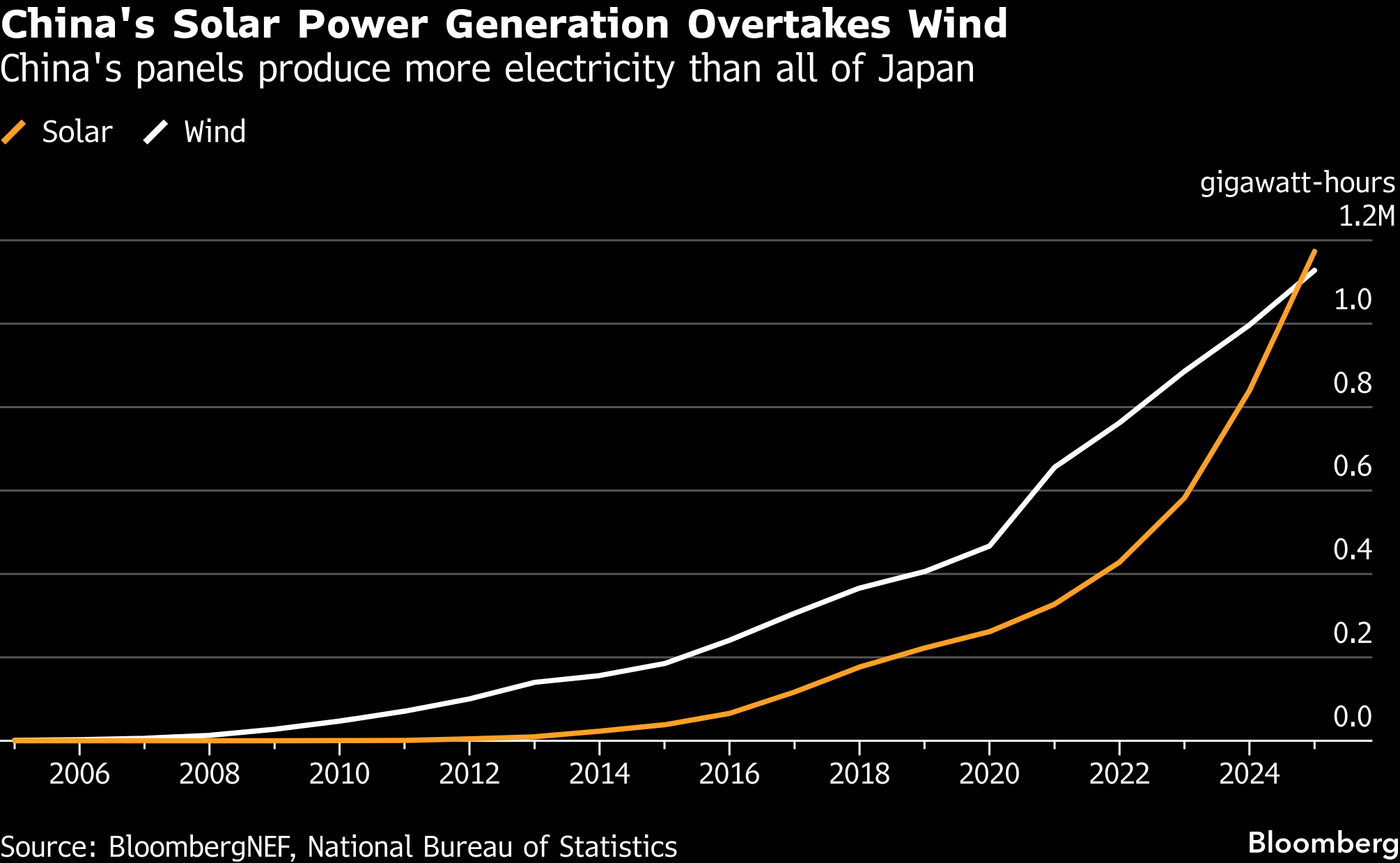
The rapid growth of renewables helped China meet its growing electricity consumption last year without the need to burn more coal at power plants, with thermal generation falling 0.7%.
Even so, coal remains the dominant source of China’s power and the fuel’s share of total energy consumption fell only marginally in 2025 to 51.4%. Total coal consumption was 0.1% higher, likely reflecting the fuel’s use in the growing coal-to-chemicals sector.
China produced more electricity using solar last year than Japan’s entire grid, and panels now account for 11% of the nation’s total generation, compared to less than 1% a decade ago. That’s the result of the huge supply chain Chinese companies have developed and the versatility of the technology, which is quick to deploy and has been adopted in a wide range of locations — from vast desert installations to small village rooftops.
Still, solar’s rise hasn’t been without complications. Most equipment manufacturers are struggling with losses because of overcapacity and low prices, while the influx of so much electricity in daylight hours means major investment is now needed in power lines and energy storage facilities to ensure the electricity doesn’t go to waste.
Wind technology tends to produce power for more hours of the day than solar, meaning it’s only now being overtaken in terms of generation — even though panels have offered greater capacity in China for several years.
Other key energy data from the statistics bureau’s release include:
- Total energy consumption rose 3.5% to 6.17 billion tons of standard coal, while primary energy production grew 3.6% to 5.13 billion tons
- Crude oil consumption rose 3.6% and natural gas use increased 2%, while retail sales of petroleum and related products fell 5.7%
- Carbon emissions per unit of GDP fell 5%, and electricity consumption increased 5%
©2026 Bloomberg L.P.








