

Shock Departure Leaves Woodside Without Its Key Gas Champion

(Bloomberg) -- The surprise exit of Woodside Energy Group Ltd. Chief Executive Officer Meg O’Neill leaves her successor with a dilemma: should the Australian company continue down the path she set of promoting massive liquefied natural gas projects when forecasts point to a glut and lower prices?
O’Neill had been a forceful advocate for two major projects: Browse — a long-delayed plan to tap vast offshore reserves in Western Australia — and an expansion of the company’s export terminal in Louisiana, which is still under construction. Her stance reflected a company forecast for a 50% jump in global LNG demand over the next decade — one of the most bullish in the industry.
But with O’Neill now set to helm oil major BP Plc in April, Woodside’s incoming CEO will need to decide whether to stay the course as a record wave of global LNG supply is poised to flood the market and drag down prices for the remainder of the decade. Coupled with a surplus of oil, Woodside will face growing questions from investors about why it is doubling down on fossil-fuel expansion at a time when supply is abundant.
“The board and the new CEO can now rethink the value destructive Browse project, which is more expensive than 70% of competing potential new gas supplies around the world, as well as the expansion of Louisiana LNG,” the Australasian Centre for Corporate Responsibility, or ACCR, said in a statement on Thursday.
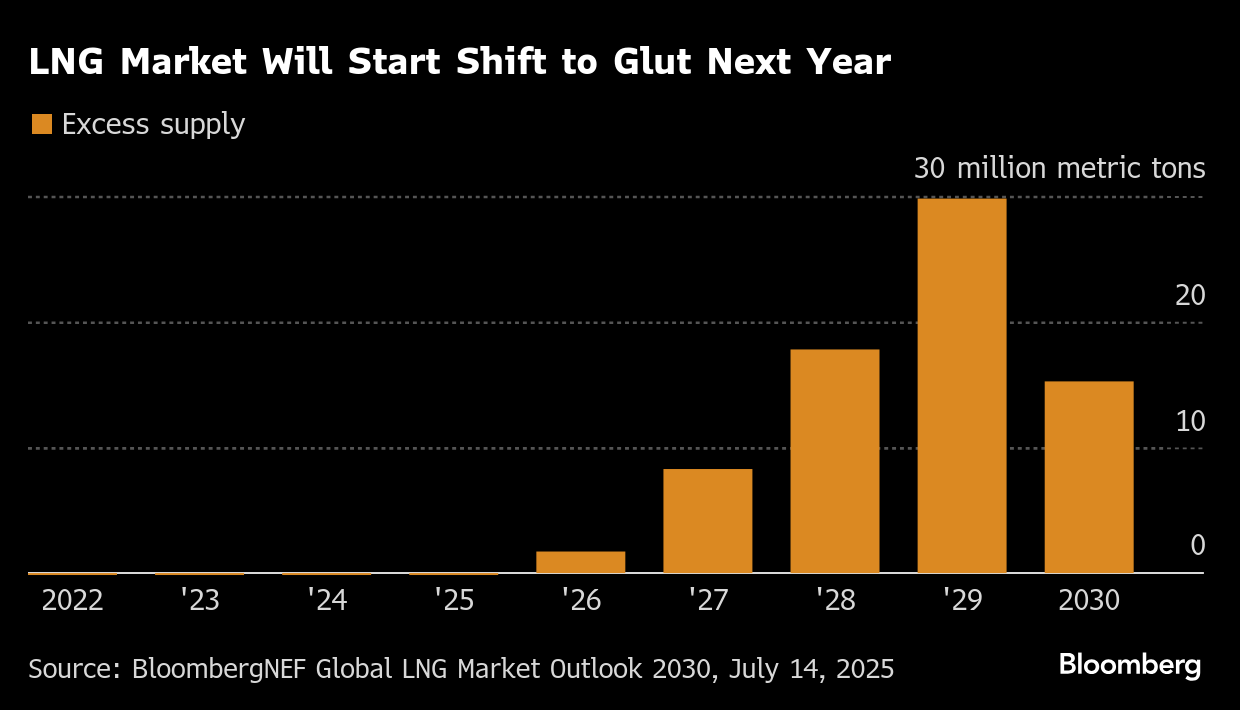
At the core of the debate is the future role of natural gas. O’Neill and other industry leaders argue that gas will help coal-dependent nations transition to a cleaner-burning fossil fuel while providing reliable backup for intermittent renewable power.
However, that outlook is in flux. Volatile LNG prices have pushed some emerging nations to rethink their reliance on imports — Pakistan, for instance, is stepping back from LNG as households and businesses turn rapidly to solar. Others, including India and China, are leaning on cheaper coal to bolster energy security and keep costs down.
Global LNG supply is set to jump by more than 50% by 2030 from 2024, far more than demand growth in recent years, Goldman Sachs Group Inc. analysts including Daan Struyven said in a note on Thursday. “LNG prices will likely have to decline significantly as this oversupply builds to incentivize additional demand,” they said.
That creates some uncertainty over Woodside’s long-term strategy, according to Bloomberg Intelligence. “O’Neill’s successor might rewrite Woodside’s gas playbook — a probability that could weigh on sentiment until the future path is clear,” analyst Anthony Chen said in a note.
One of O’Neill’s last acts was restructuring the company’s LNG trading desk, including hiring a new head from Equinor ASA, to better withstand lower prices and market the wave of new supply, according to people with knowledge of the matter.
Several contenders for the top job have already been mooted in industry circles. Woodside Chief Operating Officer Daniel Kalms and the senior vice president for M&A, Dan Hamilton, could be among potential picks, according to an industry source who has worked closely with the company.
For now, Australian Chief Operating Officer Liz Westcott is running Woodside as interim CEO. Woodside is looking at internal and external candidates and plans to announce a permanent appointment in the first quarter, it said on Thursday.
The new chief will be tasked with overseeing North West Shelf — a sprawling LNG export plant that earlier this year was granted approval to continue operating until 2070 — and the first shipment from the Scarborough offshore gas field, which is expected during the second half of next year.
They’ll also have to line up another equity partner for Woodside’s $17.5 billion Louisiana LNG project and keep the company’s foray into Mexico on track as the Trion development moves toward producing oil later this decade.
On top of that, they will have to face increasingly vocal opposition from climate campaigners and the company’s own shareholders. At a meeting in May, protesters repeatedly interrupted O’Neill’s opening address by blowing on whistles, while a year earlier Woodside investors rejected the company’s climate strategy in a non-binding vote.
“Woodside has been persistently unresponsive to shareholder concerns,” the ACCR said. “Investors will be hoping that O’Neill’s departure is a circuit breaker on Woodside’s habit of pursuing high-capex, marginal fossil fuel projects, and is an opportunity to instead start focusing on better capital returns.”
©2025 Bloomberg L.P.








