

Norway Struggles to Diversify Its Economy Hooked on Oil and Gas


(Bloomberg) -- Norway faces dwindling incentives to transition its economy away from oil and gas as it is becoming an ever more critical producer for western Europe due to global energy supply shocks.
Just a couple of years after a historic boost to the nation’s fossil fuel exports over Ukraine war-related sanctions against Russia, demand for Norway’s resources is set to persist with another war, in the Middle East, again heightening security of supply worries.
Successive governments on both sides of the political spectrum have pledged to reduce Norway’s dependence on oil and gas — highlighted by experts as a priority for more than a decade to diversify and crisis-proof the economy for a time when those reserves have run out.
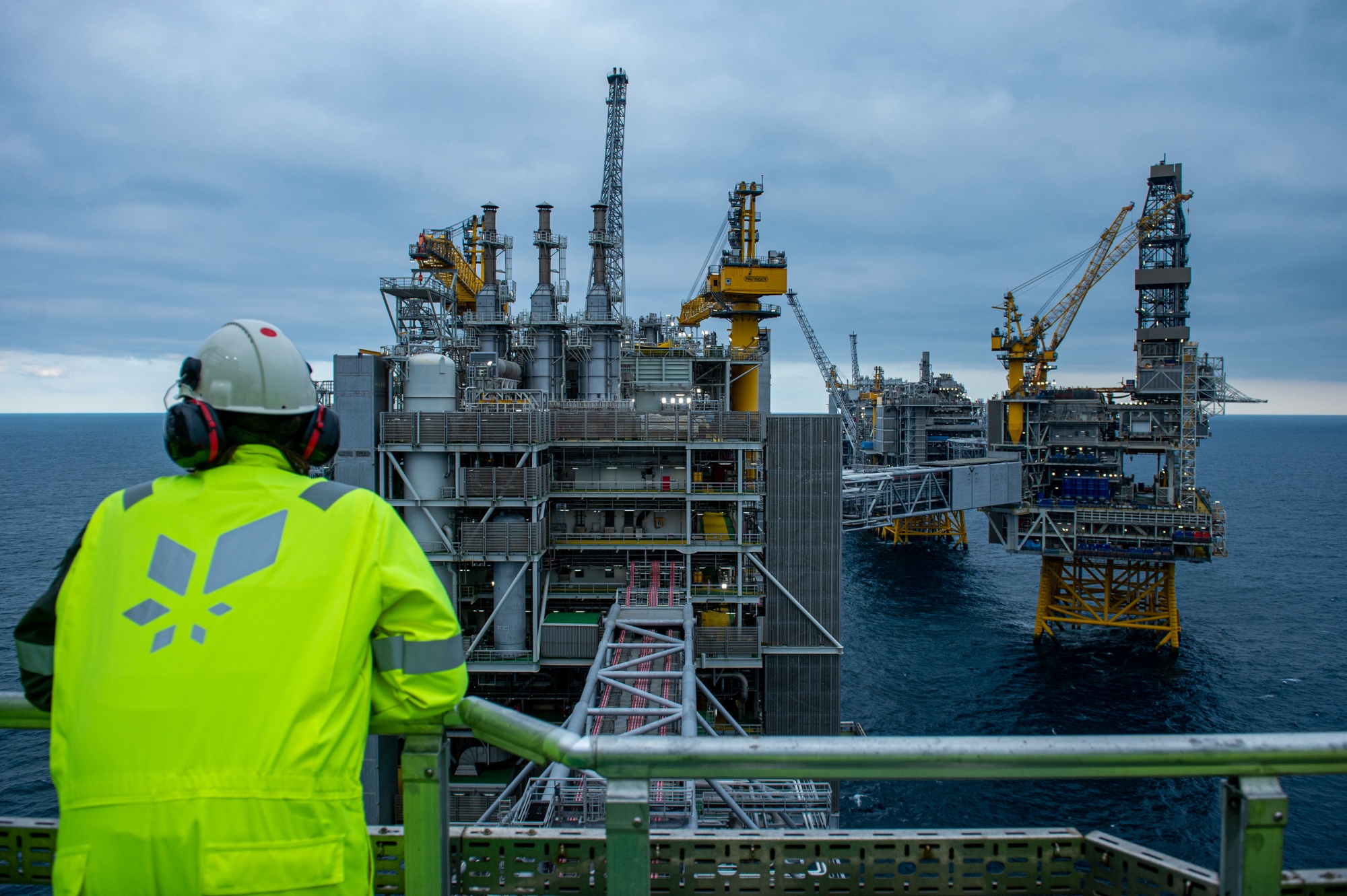
The Nordic nation, which first discovered oil in 1969, has been relatively successful at reducing carbon emissions at home, with pioneering electric-vehicle adoption or carbon capture initiatives. At the same time, it’s exposed to claims of war profiteering over its role as a major fossil fuel exporter.
While Norway has been more prudent than most other resource-rich nations by investing the fossil fuel revenue in its $2.3 trillion sovereign wealth fund, it’s struggled to foster a broad basis of industries to underpin its economy.
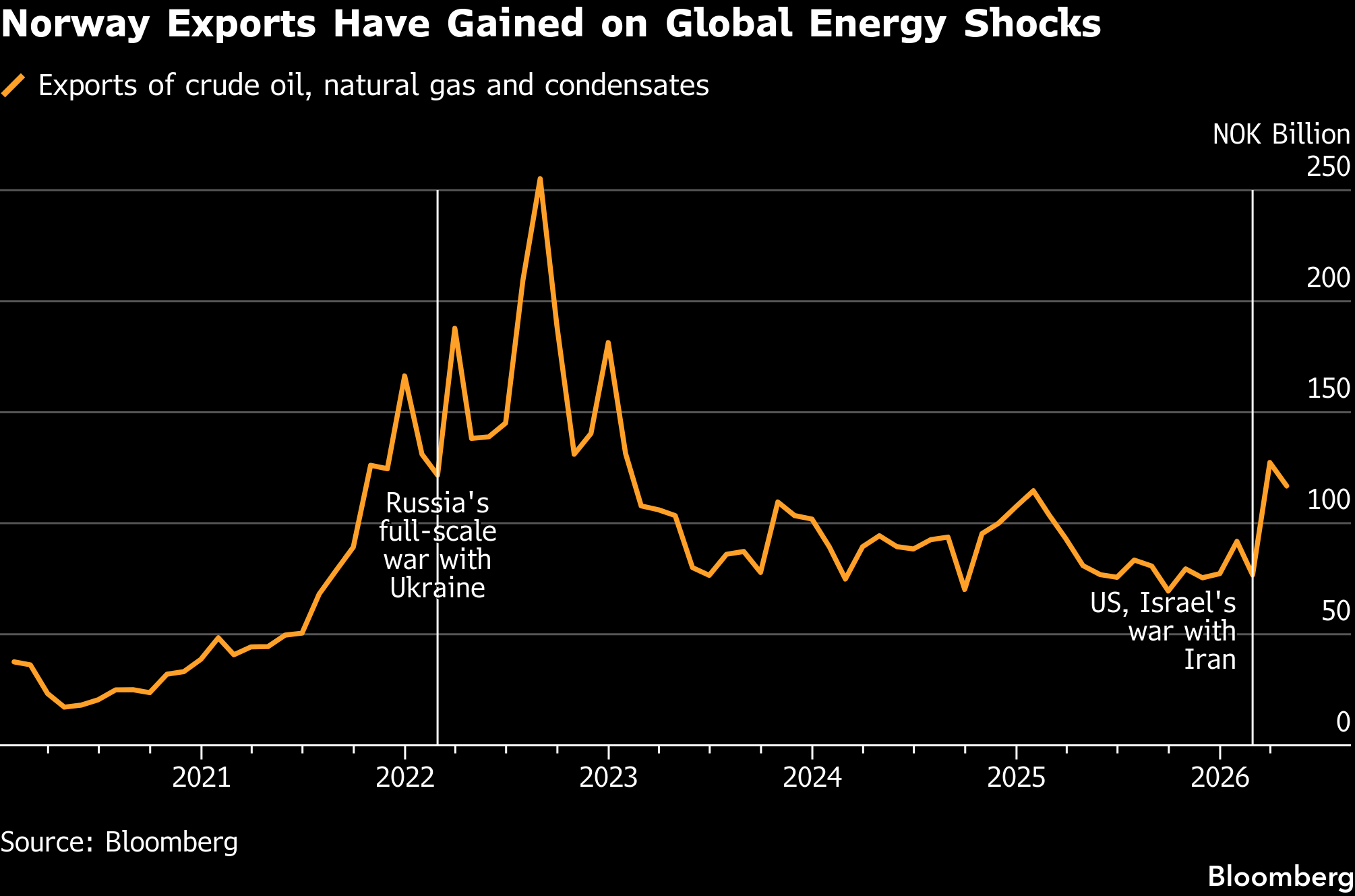
Combined oil and gas shipment volume has declined from its 2004 peak, yet petroleum is still the dominant export sector in Norway: oil and gas made up 57% of Norway’s goods sold abroad in 2025, and monthly crude sales revenue reached a record after the outbreak of the Iran war.
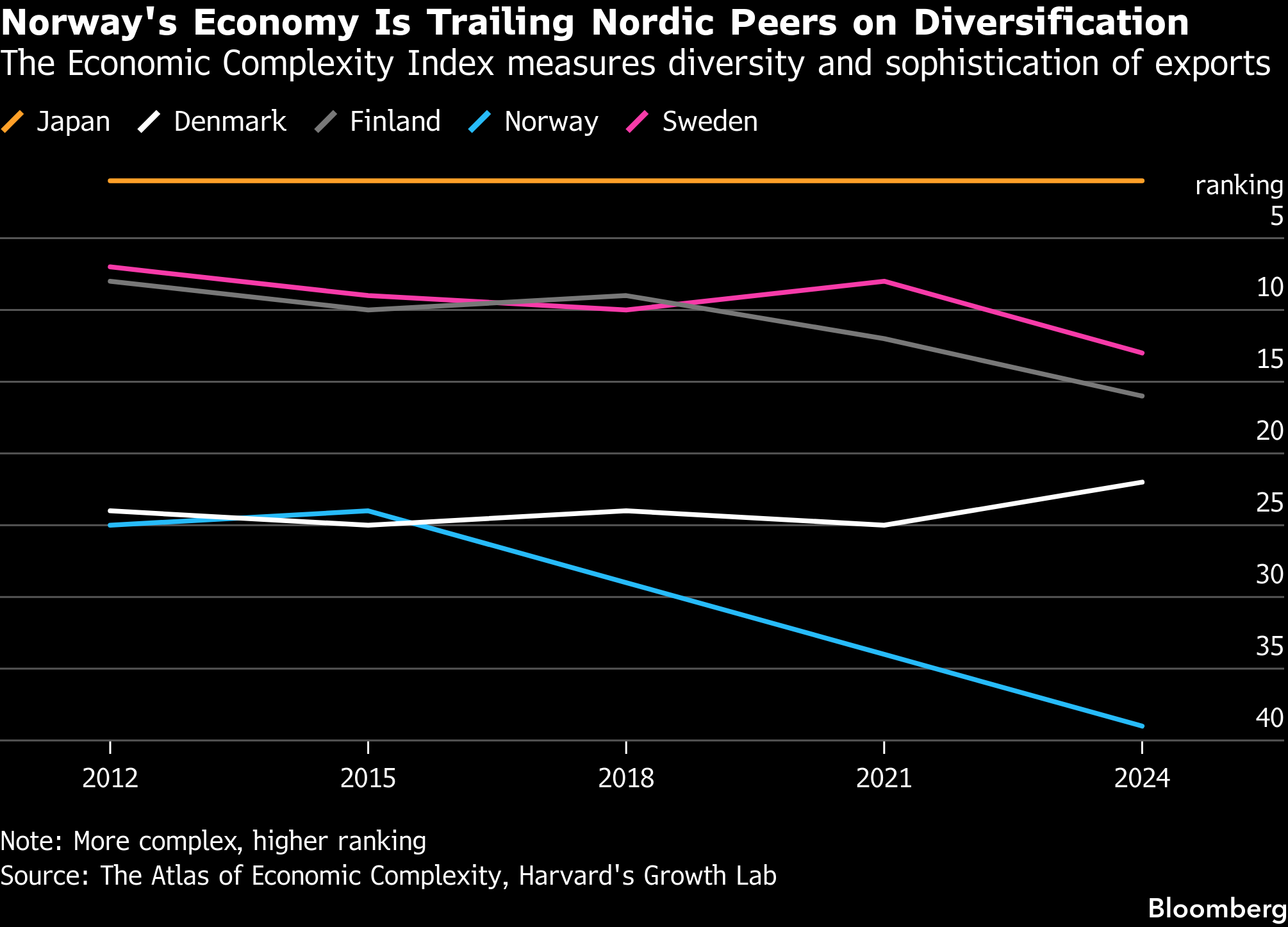
Norway’s economic diversity, meanwhile, keeps declining, underperforming that of its Nordic peers. Increasing trade protectionism and the krone’s recent strengthening to multi-year highs are likely to make export diversification even tougher.
An index of economic complexity shows Norway’s gap with the rest of Nordics has widened already since the early 2000s. The measure, developed by the Growth Lab at Harvard University, explains why wealth developments differ across countries.
With oil and gas providing more than a fifth of Norway’s total gross domestic product, services account for most of the remainder, dominated by health, education and public administration. While the fishing and aquaculture industry is a strong contributor to exports, its share of GDP is at around 3%.
Initiatives on wind power, green hydrogen or battery production have faced various difficulties in past years. Earlier this month, Morrow Batteries ASA, which manufactured cells for energy-storage installations, filed for bankruptcy. It was the latest battery venture in Europe to fail following the much-publicized demise of Swedish group Northvolt AB last year.
While the previous government of Labor Premier Jonas Gahr Store set an aim in 2021 to increase non-oil exports by 50% by the end of the decade, the progress toward that goal has largely reflected the effect of inflation and of weak currency, while only a quarter of the target is achieved if adjusted for those effects.
Cuts in this year’s budget are undermining these efforts, the country’s National Export Council, an advisory body set up to support that goal, said in a report at the end of last year.
Earlier this month, the Energy Ministry announced that it will award 70 new blocks in the North Sea, the Norwegian Sea and the Barents Sea to its annual licensing round covering the most mature exploration areas on the continental shelf. It also approved plans to reopen three gas fields, with production planned to start in 2028 and continue until 2048.
Anders Opedal, chief executive officer of energy giant Equinor ASA, said in February — before the onslaught of the Iran war — that the company has “a very high bar” for new investments in offshore wind. In April, Equinor halved its stake in local renewables developer Scatec ASA in a further realignment toward its core hydrocarbon business.
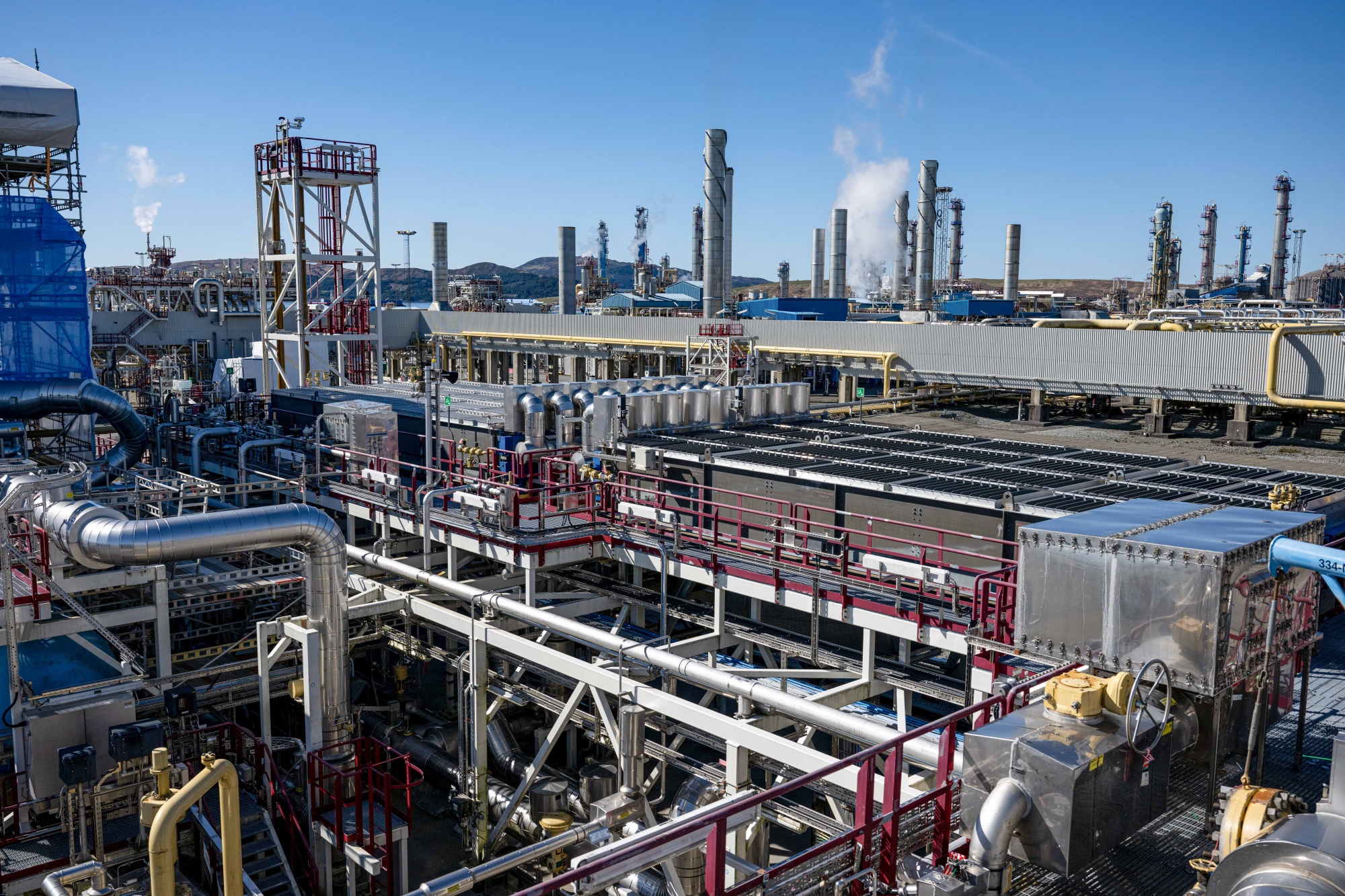
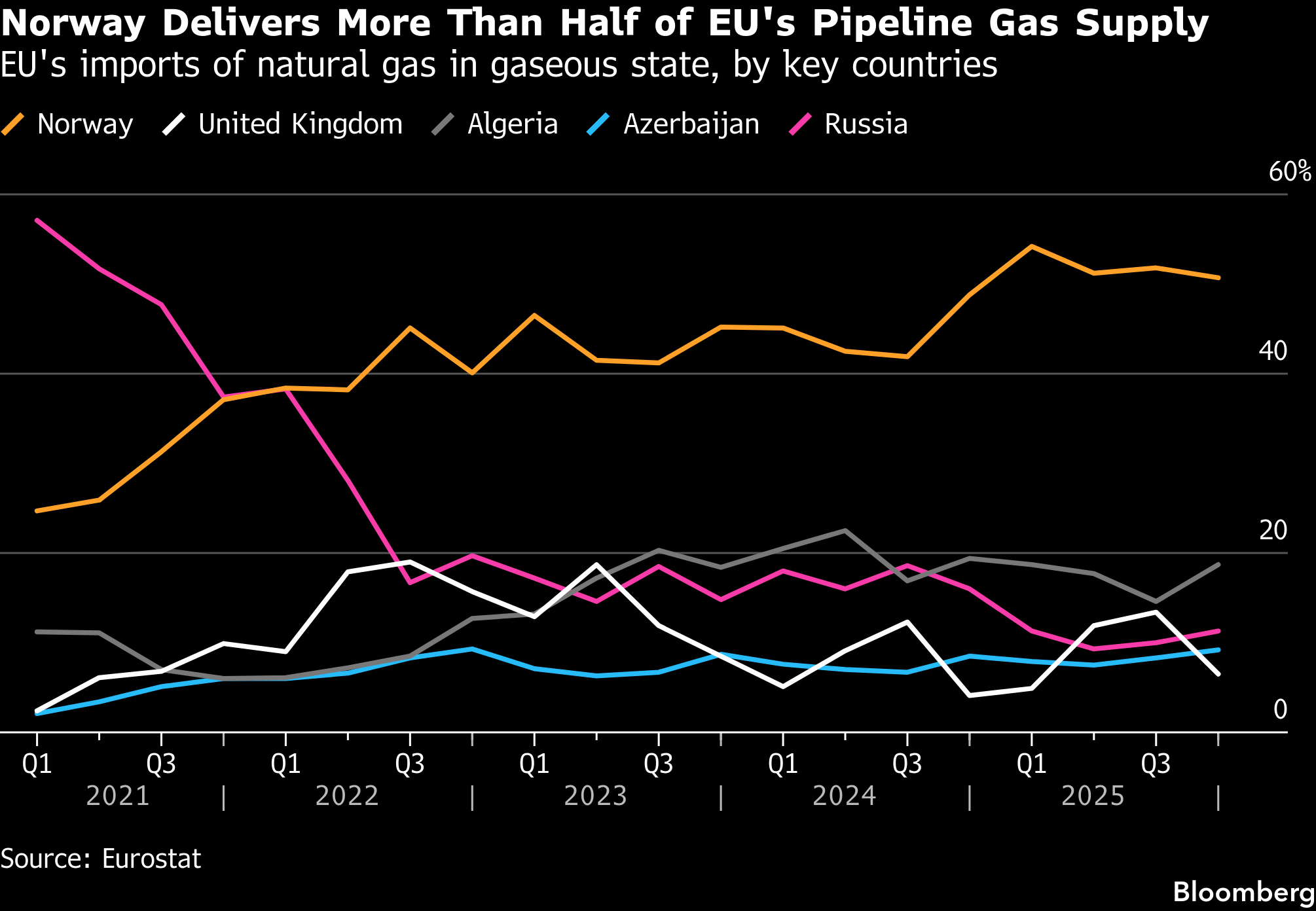
Asked whether he is worried about global trends delaying Norway’s transition away from producing oil and gas, Store on Friday referred to how his nation provides more than 30% of Europe’s gas, saying that “for Norway to say we can deliver on that for the coming years is a stabilizer.”
The green transition “will be accelerated after what's happening around the Gulf because countries will say ‘we must be less dependent on something that can be so unstable,’” he added. “We fully support that transition.”
©2026 Bloomberg L.P.