

European Gas Soars 30% on Week as ‘Perfect Storm’ Hits Market

(Bloomberg) -- European natural gas prices surged 30% this week as a change in sentiment took hold and traders rushed to cover short positions amid bouts of unusually cold weather.
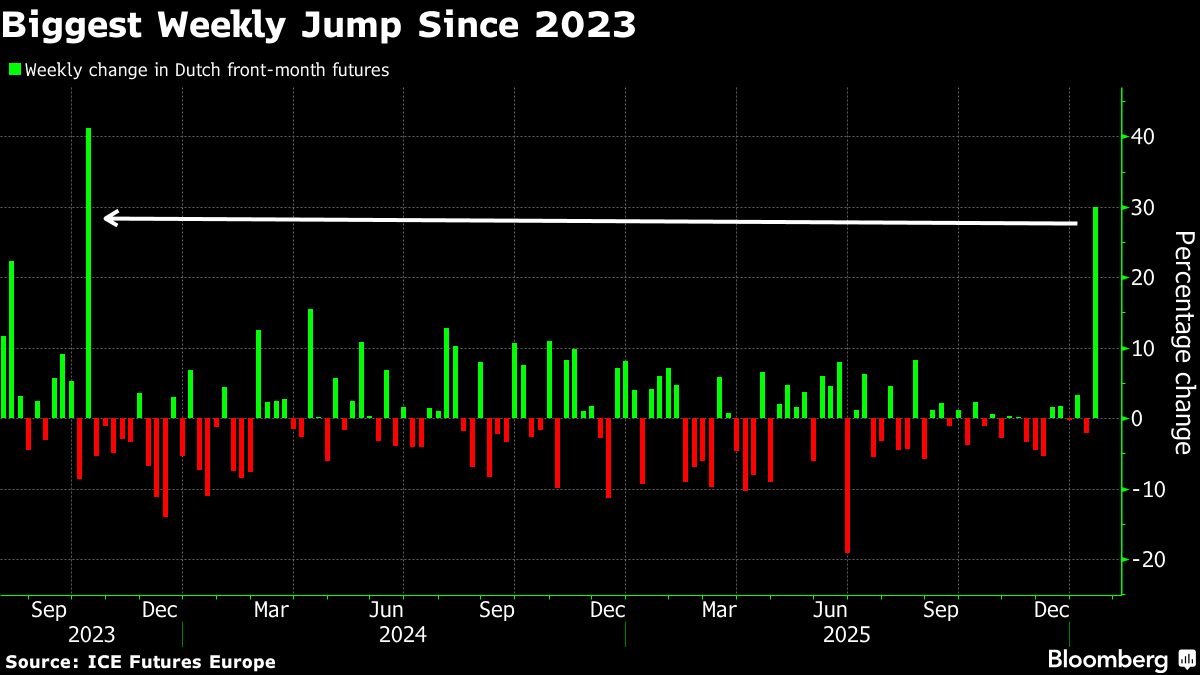
Benchmark futures broke out of months of narrow trading, posting the biggest weekly jump in over two years after US traders amplified a fresh push higher on Friday. The rally marks a significant shift in the market after stronger heating demand collided with renewed geopolitical risks.
“Sentiment has completely turned — you could almost call it a perfect storm,” said Arne Lohmann Rasmussen, chief analyst at Global Risk Management. The last time prices rose this much in a single week was when Hamas attacked Israel in October 2023, sparking fears of supply disruptions.
Prices are still far from the records seen during the 2022 energy crisis, yet the sharp rally underscores how vulnerable Europe’s gas market remains to prolonged jumps in demand and volatility. The rapid rise also showed signs of spilling over into bond markets as traders started to fret over the implications for inflation.
While Europe’s gas inventories were initially viewed as sufficient at the start of the heating season — when funds turned the most bearish on prices in almost six years — worries about the region’s supply balance have increased recently. Speculators who had bet on a weaker market started to buy futures to cover their positions, adding momentum to the rally.
Meanwhile, the continent’s gas storage sites are less than 52% full, down from a five-year seasonal average of about 67%. Hefty withdrawals have put stockpiling risks for next summer in focus, said Lohmann Rasmussen.
The rally highlights a deeper structural shift. Europe has lost much of the flexibility it once relied on to absorb supply shocks, leaving storage as one of its few remaining buffers as it procures liquefied natural gas from across the globe. Yet building up inventories often relies on summer gas contracts being cheaper than those for the following winter, a price structure that flipped this week and also posed major concerns a year ago.
While Europe has managed to attract plentiful seaborne supply this winter and Norwegian pipeline flows have been relatively steady, a plunge in temperatures boosted demand for the fuel recently. A Siberian cold blast is forecast to hit much of Europe over the next two weeks, and the region needs to maintain some price support in order to compete for cargoes with other buyers.
Geopolitical risks and speculative flows are amplifying the move, said James Waddell, head of European gas and global LNG at Energy Aspects Ltd. Cold weather in Europe and Asia, low stocks and renewed tensions involving Iran have lifted risk premiums, while traders have been forced to unwind short positions built on expectations of a swift return of Russian gas, he said.
A storm in France earlier this week also forced some nuclear facilities to go offline, further increasing reliance on gas.
The price shifts serve as a reminder of the market’s inherent volatility, said Sadnan Ali, an oil and gas analyst at HSBC Holdings Plc. He said the region’s gas benchmark remains highly sensitive to sudden weather changes, unpredictable supply outages and shifts in global demand, with recent price action reflecting short-term tightness being increasingly priced in.
Dutch front-month futures, Europe’s gas benchmark, settled higher at € a megawatt-hour on Friday.
©2026 Bloomberg L.P.