

Qatar LNG Loading Jumps Ahead of Potential Hormuz Reopening


(Bloomberg) -- Qatar is loading the most liquefied natural gas in months, as the world’s second-largest exporter of the super-chilled fuel prepares equipment for the potential reopening of the Strait of Hormuz.
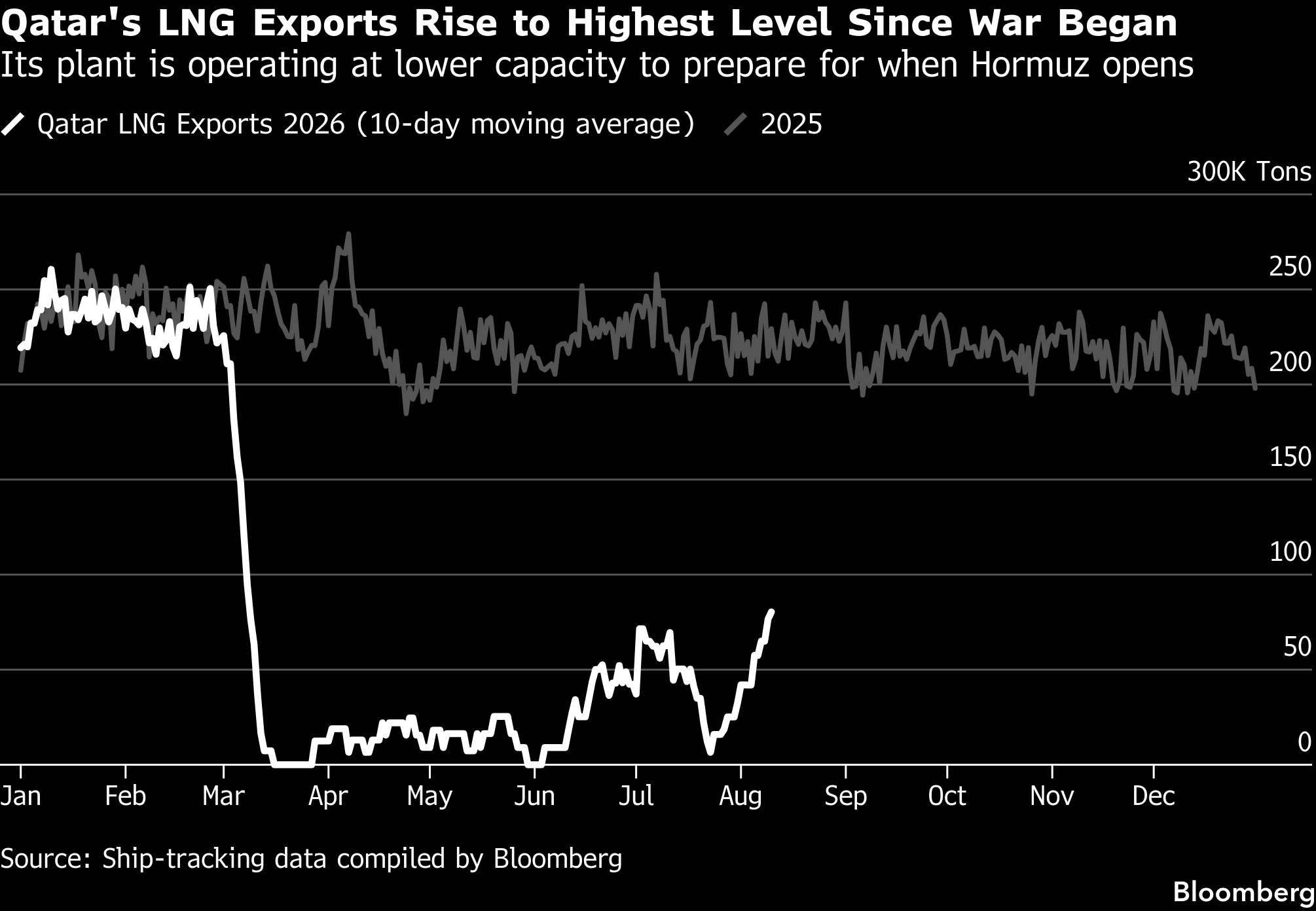
The 10-day moving average for loadings from the giant Ras Laffan complex was about 80,000 tons, according to ship-tracking data compiled by Bloomberg. While 60% lower than this time last year, it is still the highest level since March, right after the war began and Iranian attacks on the facility forced Qatar to shut production.
“Undamaged liquefaction trains at Qatar’s Ras Laffan have returned online at low levels to avoid exceeding storage capacity, easing concerns around restart delays,” consultancy Inspired Plc said in a note Tuesday. However, resuming exports back toward normal levels remains dependent on shipping conditions through Hormuz, Inspired said.
A rapid restart of production in Qatar would be welcome news for Asian importers, which are grappling with spot prices at double the rate of pre-war levels. European gas contracts have also surged as the region struggles to refill inventories for winter.
Seven of Qatar’s 14 LNG trains were showing thermal activity as of Aug. 8, matching highs seen early last month, before the recent escalation of the conflict, according to data compiled by Kpler. That indicates that the units were potentially producing some fuel. Two trains were damaged in March, and won’t return to service for at least several years.
There were also some tentative signs that flows could soon improve through Hormuz, the chokepoint for about a fifth of global supplies. Pakistan’s defense minister said on Tuesday that the US and Iran are “close to some sort of arrangement” over the waterway. Talks between Iran and Oman about reopening the channel to some maritime shipping have reached an advanced stage, Al Jazeera reported earlier, citing a Qatari Foreign Ministry spokesperson.
But a deal is still far from certain, with Iran reiterating on Tuesday that Hormuz will not be reopened until Tehran’s conditions are met.
Qatar has essentially stopped LNG flows through Hormuz since hostilities in the region rekindled last month. Two tankers carrying Qatari LNG were struck in July. This forced Qatar to pause plans to rapidly revive production.
The country has been able to keep some of its production trains in operation by delivering shipments to Kuwait, as well as loading fuel onto empty tankers in the Gulf.
However, the producer is running out of spare ships to load. There are currently six empty LNG tankers idled near the Ras Laffan facility, compared to nine carriers loaded with Qatari fuel, ship-data shows. One ship is currently docked at Ras Laffan.
©2026 Bloomberg L.P.








