

Spike in German Gas Premium Signals Persistent Storage Worries

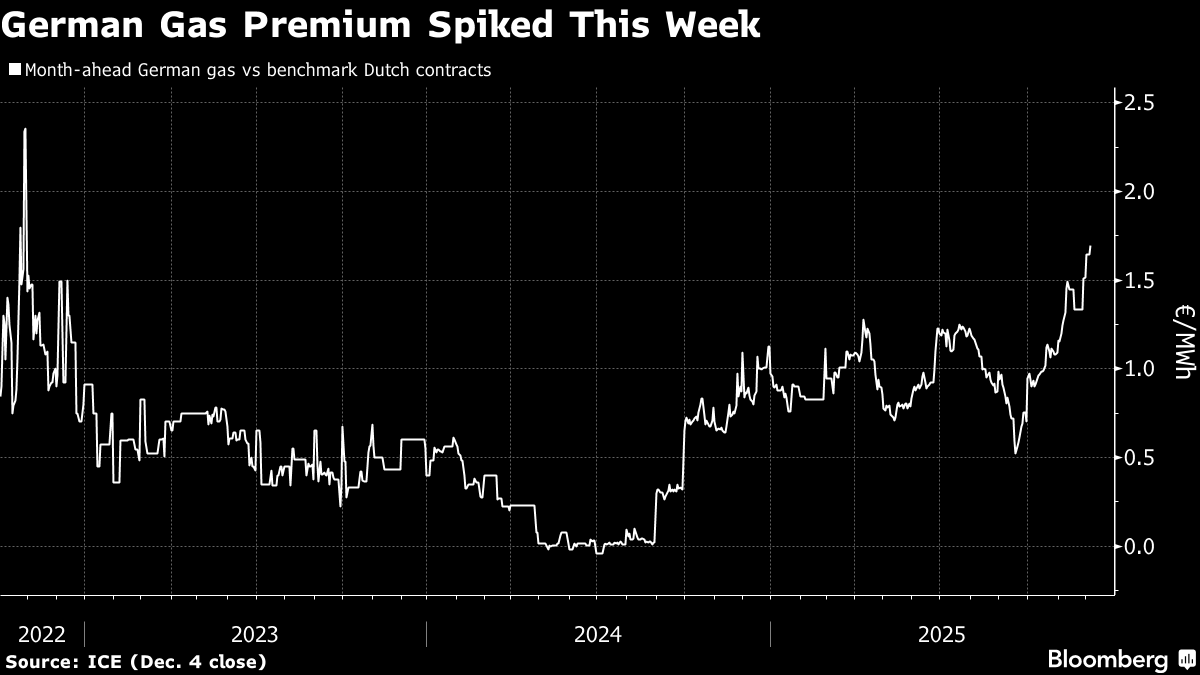
(Bloomberg) -- The premium that German natural gas futures trade above Europe’s benchmark jumped to a three-year high, signaling that concerns about its low fuel inventories remain.
German front-month contracts, known as THE, saw smaller declines this week compared to the continent’s most liquid Dutch peers, with a gap between them widening to €1.7 a megawatt-hour. That’s the most since late 2022, according to Intercontinental Exchange Inc. data compiled by Bloomberg.
Milder weather forecasts and stable supply pushed all European gas contracts lower this week. But regional futures tend to move more in line with fundamentals, while price swings in the Amsterdam-traded European benchmark are often amplified by speculative activity. The resulting price gap shows traders aren’t convinced yet that Germany is in the clear, even as they’ve grown more relaxed about Europe’s ability to get through winter.
Germany’s vast gas-storage sites are less than 66% full — below a five-year seasonal average of 86% — and the nation’s storage-operator association, INES, recently warned that fuel reserves could be fully depleted by late January under an extreme or severely cold winter scenario.
“Germany’s low storage levels heading into peak winter are certainly a major factor in the widening spread,” said Matt Drinkwater, head of European gas at Energy Aspects Ltd. Maintaining a premium helps Germany to keep drawing supply from neighboring markets and minimize withdrawals from its own inventories, he added, preserving its buffer against late-winter cold snaps.
For now, some weather forecasters expect a relatively mild December-February period both in Germany and in Europe as a whole.
Yet even in the broader European market, “the relaxed attitude” could be premature, Commerzbank AG commodity analyst Carsten Fritsch said in a note. “Winter has only just begun and is likely to bring several more cold spells,” he said.
©2025 Bloomberg L.P.